UPDATE: Tornadoes, Extreme Weather And Climate Change, Revisited
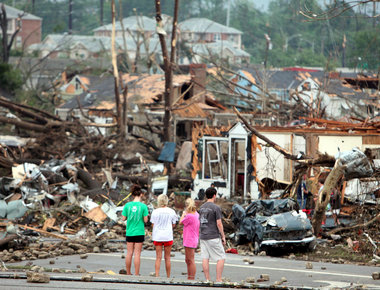
“Likely …. the most prolific five-day period of tornado activity on record for so early in the year”

UPDATE: Tornadoes, Extreme Weather And Climate Change, Revisited
“Likely …. the most prolific five-day period of tornado activity on record for so early in the year”
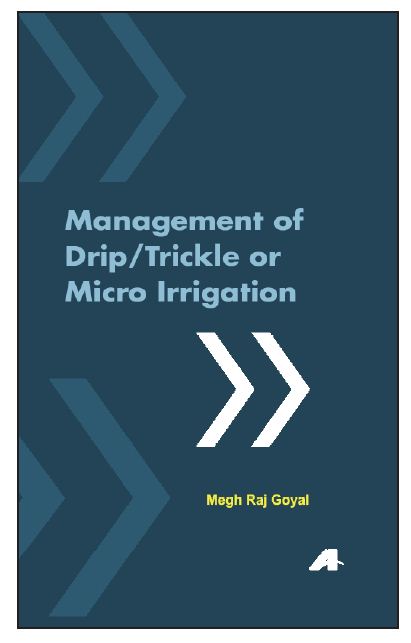
Management of Drip/Trickle or Micro Irrigation
By Megh R. Goyal, PhD, Professor in Agricultural and Biomedical Engineering, University of Puerto Rico
http://www.appleacademicpress.com
This important book—the only complete, one-stop manual on microirrigation worldwide—offers knowledge and techniques necessary to develop and manage a drip/trickle or micro irrigation system. The simplicity of the contents facilitates a technician to develop an effective micro irrigation system. Management of Drip/Trickle or Micro Irrigation includes the basic considerations relating to soil-water-plant interactions, with topics such as methods for soil moisture measurement; evapotranspiration; irrigation systems; tensiometer use and installation; principles of drip/ micro/trickle irrigation; filtration systems; automation; chloration; service and maintenance; design of drip irrigation and lateral lines; the evaluation of uniformity of application; and an economical analysis for selecting irrigation technology.
Rescued Meteorological Data for the Caribbean Region – Excellent Historical Resource
These data are stored in NOAA’s digital library under the heading: Data Rescue Caribbean. Many of the recorded measurements are from the first half of the 20th Century.
For other interesting historical NOAA documents, check out the following link: http://docs.lib.noaa.gov/rescue/
CLIMATE IMPACT EQUITY LENS (CIEL) – CLIMATE CHANGE GETS PERSONAL
Spanish Version
The Climate Impact Equity Lens (CIEL) is a new tool for comparing the net climate impacts felt by diverse individuals around the world, and for tracking individual impacts over time. CIEL demonstrates that climate change will affect each person differently.
At present, very little is being done to prevent dangerous climate change. Some people are already experiencing damages from changing temperatures and weather patterns, and from sea-level rise – but everyone is enjoying the “benefit” of not paying for more ambitious emission reductions. Looking only at today’s impacts, most – but not all – of us are net winners (saving more from inaction than we lose from climate damages). Over the course of this century, net losers will become more common; in the next century, it will be hard to find people who still benefit from inaction.
CIEL provides a graphic display of changes over time in each individual’s net economic impact from climate change. You can download several CIEL publications and a tool that allows you to input individual characteristics to estimate the personal impact of climate change.
The Climate Impact Equity Lens (CIEL) is a new tool for comparing the net climate impacts felt by diverse individuals around the world, and for tracking individual impacts over time. CIEL demonstrates that climate change will affect each person differently.
(Excerpted from CIEL website, 2011, Stockholm Environment Institute, 11 Curtis Avenue, Somerville, MA 02145, USA. Phone: 1(617) 627-3786. Email: CIEL@sei-us.org)
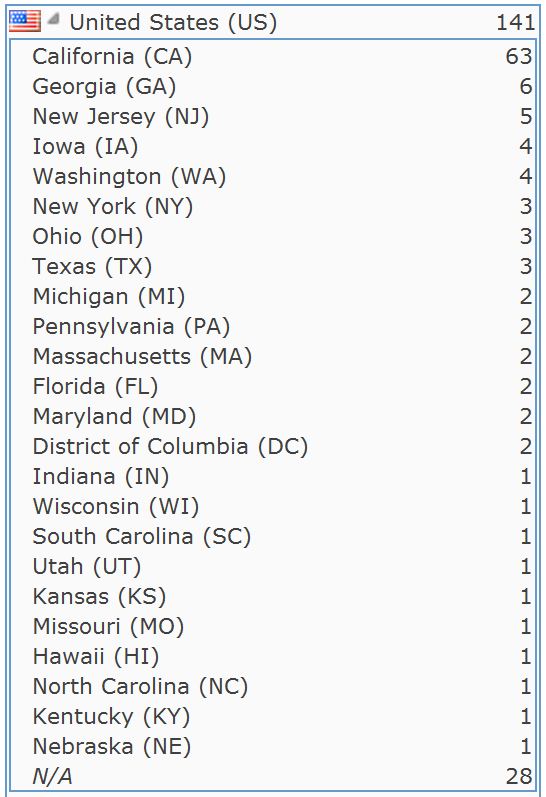
Two weeks ago, pragwater.com started using a free online service called ClusterMaps. We were happy to learn that pragwater.com has received visits from people all over the world, 27 countries in all. Here is the breakdown:

Estudio Sobre El Uso De Agua Agrícola En Puerto Rico
This report provides agricultural water requirements for Puerto Rico through 2025.
 VLab: An excellent free Online Resource for Hydraulics/Hydrologic Calculations: http://onlinecalc.sdsu.edu/. Thank you to Dr. Victor Miguel Ponce for your contribution to an Open Source web!
Here are four irrigation discussion groups you may want to consider subscribing to. I have been a member of Irr-L for years and have found it invaluable. The information below came from the following website: http://www.trickle-l.com/new/onthenet/
There are four distinct irrigation discussion groups: Irrigation-L, Trickle-L, Salinity-L and SoWaCS.
The purpose of Irrigation-L is to cover technical aspects of irrigation like design, hydraulics, and system layouts. It is also open for topics like irrigation management, socio-cultural, political and economic questions relevant to irrigation.
Trickle-L focuses on all aspects of drip irrigation technology that is sometimes referred to as Microirrigation.
Salinity-L discusses the management practices of saline soils along with more detailed discussions of salt movement in the soil and crop salt tolerance.
SoWaCS or Soil Water Content Sensors is a discussion list which obviously focuses on methods and techniques used to measure soil water content and soil water potential.
All of the above discussion groups are operated by a listserver. A listserver automatically distributes an e-mail message from one member of the list to all other members on the list. When you subscribe to a list, your name and e-mail address is automatically added to it. To subscribe to any of the four lists above, send in the E-mail message (without the quotes), “subscribe (name of list) your name to the following addresses:
For IRRIGATION-L: LISTSERV@listserv.gmd.de (or if this doesn’t work use LISTSERV@listserv.dfn.de)
TRICKLE-L : http://list.vi-dev.com/listinfo/trickle-l
For Salinity-L: LISTSERV@crcvms.unl.edu
For SoWaCs: Majordomo@aqua.ccwr.ac.za
When you subscribe using one of the above email addresses, put SUSCRIBE ###-L (where ### is IRRIGATION or TRICKLE or Salininty or SoWaCs) and YOUR NAME in the subject line, with of course YOUR NAME being your own name.
Eric
GOES-Puerto Rico Water and Energy Balance (GOES-PRWEB) 2010 results: http://wp.me/P1s0De-9j
The page now includes many more images for 2010. In addition to the water balance components, the following images are provided:
Transient Variables/Parameters
Air temperature, minimum air temperature, maximum air temperature, effective surface temperature, relative humidity, wind speed, saturated vapor pressure, actual vapor pressure, solar radiation, aerodynamic resistance (Ra), surface resistance (Rs), soil moisture, crop coefficient (Kc), crop stress factor (Ks), net radiation, latent heat flux and sensible heat flux.
Non-transient Parameters:
Surface elevation, Percent sand, silt and clay, field capacity, wilting point, land use/land cover, zero plane displacement and surface roughness, and albedo.
 PRAGWATER