New Climate research from last week 22/2012

New Climate research from last week 22/2012

“This week we have really cool collection of new papers. We have special section for papers on Greenland ice sheet – past, present, and future. Another special section deals with Arctic affairs – cryosphere, atmosphere, and biosphere. We also have other papers on diverse subjects, such as biomass burning, ENSO, Italian newspapers, Great Cormorants, black carbon, and diurnal temperature range.”  – Skeptical Science

Renewable energy growth helps offset greenhouse gas increases

Renewable energy growth helps offset greenhouse gas increases

The strong growth in renewable energy sources has helped offset an increase in greenhouse gas emissions, according to official figures released today by the European Environment Agency (EEA).  more

Conservando nuestros recursos naturales

Conservando nuestros recursos naturales

Here is an excellent website from the the UPR Agricultural Extension Service. The author of the website is Carmen González Toro, Especialista en Ambiente.

Evapotranspiration in Puerto Rico, Parts 1-5 on Youtube

IITF Science Seminar Series
USDA Forest Service International Institute of Tropical Forestry (IITF)

Satellite-Based Daily Evapotranpiration Estimation in Puerto Rico
Presented by Eric Harmsen

Part 1 Part 2 Part 3 Part 4 Part 5

Since this presentation was given in June of 2009, we have completed the operational version of the GOES-Puerto Rico Water and Energy Balance algorithm (GOES-PRWEB). For more information click HERE.

Course offerings next semester at UPRM: Ag Hydrology and Agroclimatology

I will be offering the following two courses next semester at UPR-Mayaguez. Please click links for more information.

TMAG 4038 Agricultural Hydrology

TMAG 5017 Agroclimatology

Must-Read: Tom Friedman On Climate Change And ‘The Other Arab Spring’

Must-Read: Tom Friedman On Climate Change And ‘The Other Arab Spring’


NOAA concluded in 2011 that “human-caused climate change [is now] a major factor in more frequent Mediterranean droughts.” Reds and oranges highlight lands around the Mediterranean that experienced significantly drier winters during 1971-2010 than the comparison period of 1902-2010.

GOES-PUERTO RICO WATER AND ENERGY BALANCE (GOES-PRWEB) IS NOW OPERATIONAL

GOES-PRWEB is finally operational.  I would like to thank my student, Victor Reventos, who made it possible through his Python programming skills.  Here is a link to the results:

http://academic.uprm.edu/hdc/GOES-PRWEB_RESULTS/

New results will be published daily.  Historical results are available from January 1, 2010. A list of the available output is provided below.

For information on GOES-PRWEB please visit the following link:

https://pragwater.com/goes-puerto-rico-water-and-energy-balance-goes-web-algorithm/

Eric Harmsen

GOES-PRWEB RESULTS
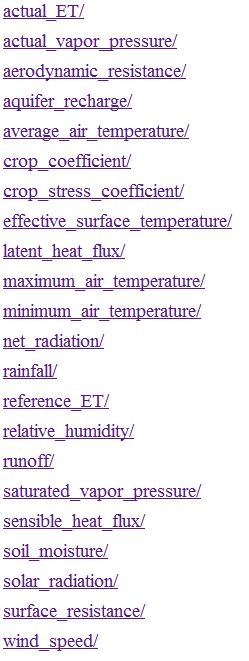

NON-TRANSIENT PARAMETERS


ACKNOWLEDGEMENTS: This research received partial funding from the following sources: NOAA-CREST (grant NA06OAR4810162) and USDA Hatch Project (Hatch-402). Special thanks to Dr. John Mecikalski for providing the solar radiation data, and Alejandra Rojas for providing various GIS maps used in this research.

DISCLAIMER: The information is provided “as is”. The authors and publishers of this information disclaim any loss or liability, either directly or indirectly as a consequence of applying the information provided herein, or in regard to the use and application of said information. No guarantee is given, either expressed or implied, in regard to the accuracy, or acceptability of the information.

GOES-PRWEB TO BECOME OPERATIONAL

Dear Friends

Total estimated actual evapotranspiration for 2010 derived from the GOES-PRWEB algorithm.

I am sending out this “heads up” to let you know that within the next few days the GOES-Puerto Rico Water and Energy Balance (PRWEB) model will become operational.   “Operational” means that the results will appear on the website everyday.  The water and energy balance results, and all other environmental parameters will be published in “near real-time” (i.e., through yesterday’s date).   In other words, if you visit the website on April 2, 2012, for example, the results will be current up through April 1, 2012.  In addition, graphic results will be provided on a daily basis starting from January 1, 2010.

As always, feel free to respond to my posts with questions or comments.

Eric

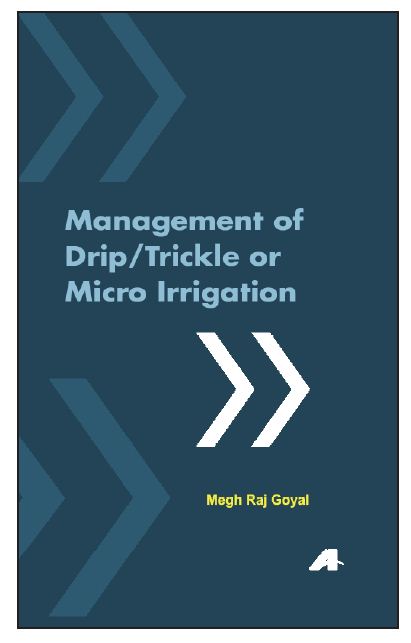
New Book Announcement: Management of Drip/Trickle or Micro Irrigation – Forthcoming Spring 2012

Management of Drip/Trickle or Micro Irrigation
By Megh R. Goyal, PhD, Professor in Agricultural and Biomedical Engineering, University of Puerto Rico

http://www.appleacademicpress.com

This important book—the only complete, one-stop manual on microirrigation worldwide—offers knowledge and techniques necessary to develop and manage a drip/trickle or micro irrigation system. The simplicity of the contents facilitates a technician to develop an effective micro irrigation system. Management of Drip/Trickle or Micro Irrigation includes the basic considerations relating to soil-water-plant interactions, with topics such as methods for soil moisture measurement; evapotranspiration; irrigation systems; tensiometer use and installation; principles of drip/ micro/trickle irrigation; filtration systems; automation; chloration; service and maintenance; design of drip irrigation and lateral lines; the evaluation of uniformity of application; and an economical analysis for selecting irrigation technology.

NASA: Human Activity, Not Solar Activity, Drives Global Warming and Returning to 350 ppm Is Needed to Stop It

NASA: Human Activity, Not Solar Activity, Drives Global Warming and Returning to 350 ppm Is Needed to Stop It

See also: http://www.giss.nasa.gov/research/briefs/hansen_16/