WEB-BASED IRRIGATION SCHEDULING TOOL FOR PUERTO RICO

Map_attribution

There are various approaches for scheduling irrigation.  One approach is to supplement rainfall with enough irrigation so that the cumulative rainfall and irrigation, over a specific period of time (e.g., one day, one week, one season),  matches the estimated crop water requirement.

The information on this page will allow you to schedule your irrigation in this manner. Here is how it works:

1. First, and this is the hardest part, create an evapotranspiration crop coefficient (Kc) curve for your crop.  The following link to the Food and Agriculture Organization (FAO) Document No. 56 provides guidance on the construction of a Kc curve: CLICK HERE.  Your Kc curve should look like FAO 56 Figure no. 34 when you are finished. (FYI: Crop coeffiecient curves can also be created using the PRET computer program)

2. Now it gets easier.  Go to the appropriate reference evapotranspion (ETo) map(s) for Puerto Rico and determine the ETo for your location CLICK HERE.  Note, if you are irrigating ever day, then you only need to obtain the ETo for yesterday’s date.  If, however, you are irrigating once per week, for example, then you will need to get the ETo values from the maps for the previous week. In this latter example, you will need to sum the daily values of ETo to obtain a value of the weekly ETo.

3. From your Kc curve, determine a representative value of Kc for the time period of your analysis (e.g., daily or weekly).

4. Estimate the crop water requirement (crop evapotranspiration)  ETc = Kc x ETo.

5. Estimatate the required depth of irrigation:  Irrigation = ET – Rainfall.  If the estimated Irrigation is negative, then you do not need to irrigate.

It is recommended that you measure the rainfall on your farm with a rain gauge, however, if you do not have access to the measured rainfall, you can obtain an estimate of the rainfall (derived from NEXRAD radar) by clicking here.

The irrigation scheduling approach described above is based on various simplifying assumptions (e.g., surface runoff and deep percolation are ignored).  Nevertheless, it will vastly improve your water management if you are not currently using an irrigation scheduling method.    To evaluate your irrigation management, you may want to construct a graph similar to the example provided below.  The graph shows the cumalative depth of  irrigation and ETc plotted with time.  If these two curves stay close together then you are doing a pretty good job of managing your irrigation.

Example of the cumulative irrigation and ET plotted with time for a crop season. The goal of irrigation scheduling is to try to match the applied irrigation with the ET. By the end of the season, the cumulative irrigation should more or less equal the cumulative ET.

The methods used to obtain ETo and rainfall can be obtained at the following website: GOES-Puerto Rico Water and Energy Balance (GOES-WEB) Algorithm

For another method of irrigation scheduling that takes into account soil moisture, see A simple Irrigation Scheduling Spreadsheet Program

DISCLAIMER: The information is provided “as is”. The authors and publishers of this information disclaim any loss or liability, either directly or indirectly as a consequence of applying the information provided herein, or in regard to the use and application of said information. No guarantee is given, either expressed or implied, in regard to the accuracy, or acceptability of the information.

GOES-PUERTO RICO WATER AND ENERGY BALANCE (GOES-PRWEB) IS NOW OPERATIONAL

GOES-PRWEB is finally operational.  I would like to thank my student, Victor Reventos, who made it possible through his Python programming skills.  Here is a link to the results:

http://academic.uprm.edu/hdc/GOES-PRWEB_RESULTS/

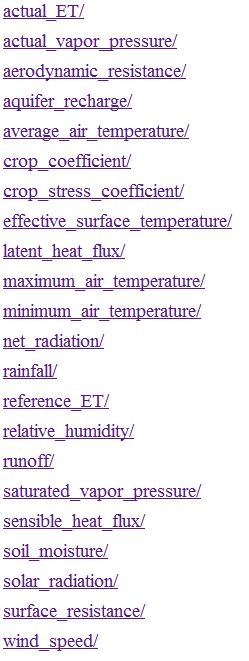
New results will be published daily.  Historical results are available from January 1, 2010. A list of the available output is provided below.

For information on GOES-PRWEB please visit the following link:

https://pragwater.com/goes-puerto-rico-water-and-energy-balance-goes-web-algorithm/

Eric Harmsen

GOES-PRWEB RESULTS


NON-TRANSIENT PARAMETERS


ACKNOWLEDGEMENTS: This research received partial funding from the following sources: NOAA-CREST (grant NA06OAR4810162) and USDA Hatch Project (Hatch-402). Special thanks to Dr. John Mecikalski for providing the solar radiation data, and Alejandra Rojas for providing various GIS maps used in this research.

DISCLAIMER: The information is provided “as is”. The authors and publishers of this information disclaim any loss or liability, either directly or indirectly as a consequence of applying the information provided herein, or in regard to the use and application of said information. No guarantee is given, either expressed or implied, in regard to the accuracy, or acceptability of the information.

GOES-PRWEB TO BECOME OPERATIONAL

Dear Friends

Total estimated actual evapotranspiration for 2010 derived from the GOES-PRWEB algorithm.

I am sending out this “heads up” to let you know that within the next few days the GOES-Puerto Rico Water and Energy Balance (PRWEB) model will become operational.   “Operational” means that the results will appear on the website everyday.  The water and energy balance results, and all other environmental parameters will be published in “near real-time” (i.e., through yesterday’s date).   In other words, if you visit the website on April 2, 2012, for example, the results will be current up through April 1, 2012.  In addition, graphic results will be provided on a daily basis starting from January 1, 2010.

As always, feel free to respond to my posts with questions or comments.

Eric

AGROVISIÓN – Sábado 24 de Marzo

The Clinton Foundation Backs Solar in Haiti

The Clinton Foundation Backs Solar in Haiti

Original Article on Cooler Planet


Hourly and daily integrated solar radiation data for the Northern Caribbean can be downloaded from the following link: https://pragwater.com/solar-radiation-data-for-pr-dr-and-haiti/

Plenitud de Puerto Rico – Iniciativas Ecoeducativas

Plenitud Iniciativas

Demostrando y proveyendo conocimientos para una vida sustentable y armoniosa.

Ubiquitous Energy: A Solar Game-Changer?

Ubiquitous Energy

We need this!

Download solar radiation data for the Northern Caribbean

Solar projects continue in rural Haiti

Solar projects continue in rural Haiti

Pragwater.com is proud to support the design of solar radiation projects in Haiti.

CLICK HERE to download hourly or daily integrated solar radiation data for Haiti.

Causa probable para los arrestados en caso de molinos de viento de Pattern Energy Group en Santa Isabel, Puerto Rico

http://frapuertorico.wordpress.com
Email: frente.rescate.agricola@gmail.com

Facebook: Frente de Rescate Agrícola (FRA)

LA UPR VENDERÁ TERRENOS EN GURABO Piden 10 cuerdas para construir una escuela pública

23 de febrero de 2012

LA UPR VENDERÁ TERRENOS EN GURABO
Piden 10 cuerdas para construir una escuela pública

El presidente de la UPR no quiso especular sobre la cantidad de dinero que recibirán por los terrenos en Gurabo. (Archivo / Ángel M. Rivera)
Por Cynthia López Cabán / End.cynthia.lopez@elnuevodia.com
La Universidad de Puerto Rico (UPR) avaló la construcción de una escuela pública en los terrenos de la Estación Experimental que la institución mantiene en Gurabo, los mismos que el año pasado fueron eje de una controversia con la administración municipal.
Como parte de la transacción, la UPR planea vender 10 cuerdas de terreno para desarrollar un plantel del proyecto de Escuelas para el Siglo 21, que impulsa el gobernador Luis Fortuño.
En entrevista con El Nuevo Día, el presidente de la UPR, Miguel Muñoz, explicó que recibió una petición de compra de terreno de la Autoridad para el Financiamiento de Infraestructura (AFI) y la Autoridad de Edificios Públicos.
“Eso es una iniciativa que siempre he apoyado. Especialmente una escuela modelo que va acorde con la misión de la Universidad”, afirmó Muñoz.
El año pasado, el alcalde de Gurabo, Víctor Ortiz, impulsó sin éxito una medida para que la Legislatura obligara a la UPR a permutar 100 cuerdas de alto valor agrícola y de investigación de la Estación Experimental de Gurabo por unas 62.7 cuerdas de terrenos, mayormente inundables.
Ortiz impulsaba la permuta para construir en el lugar una escuela, un residencial público, un hospital, un colegio de enfermería y un proyecto de viviendas de interés social.
Este canje forzoso recibió el rechazo de la comunidad universitaria porque usurpaba facultades de la institución y la despojaba de terrenos de alto valor agrícola y de investigación. Pero durante el debate que generó la polémica, Muñoz expresó en varias ocasiones que favorecía una propuesta para la construcción de una escuela modelo.
Pese a que Fortuño rechazó la permuta, favoreció que la UPR cediera terrenos de la Estación Experimental para la construcción de una escuela y un hospital.
Ayer, Muñoz reiteró que la UPR podría apadrinar la escuela con personal y recursos técnicos.
Permiso de los síndicos
Muñoz detalló, a preguntas de este diario, que la semana pasada pidió autorización a la Junta de Síndicos para que AFI entre a la Estación Experimental a realizar los estudios del suelo necesarios para la construcción.
Las tierras que serán evaluadas próximamente colindan con la carretera 189 y forman parte de los terrenos que codiciaba el alcalde de Gurabo.
Sin embargo, Muñoz no pudo garantizar que no se verá afectada la finca de cosecha orgánica de la Estación Experimental, una de las pocas que existen en la Isla con certificación del Departamento federal de Agricultura.
“En este momento no te lo puedo asegurar”, respondió.
“El proyecto (de la finca orgánica) podría establecerse en otra parte, de ser necesario”, agregó.
Señaló también que la venta se realizará al precio de tasación e insistió que esta transacción tendrá “el menor impacto posible en las actividades de investigación”.
No especuló sobre los ingresos que generaría la UPR con esta venta.
“El terreno allí tiene mucho valor”, indicó Muñoz.