Estimate the long-term average weather conditions at any location in Puerto Rico

Estimate the long-term average weather conditions at any location in Puerto Rico using the PRET computer program. Although the program is intended to estimate the monthly and daily evapotranspiration, you can also obtain monthly values of minimum and maximum air temperature, dew point temperature, wind velocity and solar radiation. Here are the steps:

1. Download PRET from the following link: https://pragwater.com/crop-water-use/ Background documentation is available at this site which describes the methods used to estimate the long-term weather data.
2. Install PRET on your computer.
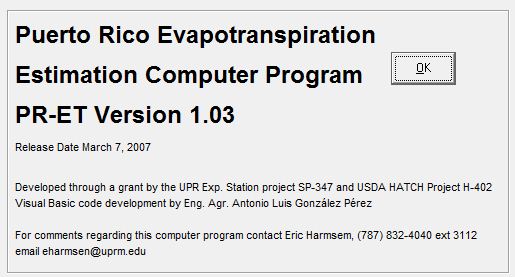
3. Run PRET. You will see the splash screen below. Click on OK.
4. On the INPUT DATA screen, enter any crop from the drop down screen (e.g., tomato). Do not use “generic”, otherwise you will need to enter some crop coefficient information later. Enter the name of your location (e.g., Juana Diaz), enter your site latitude (e.g., 18.06) and your site elevation (e.g., 55 m). Ignore all other requested input on the page. click Next.

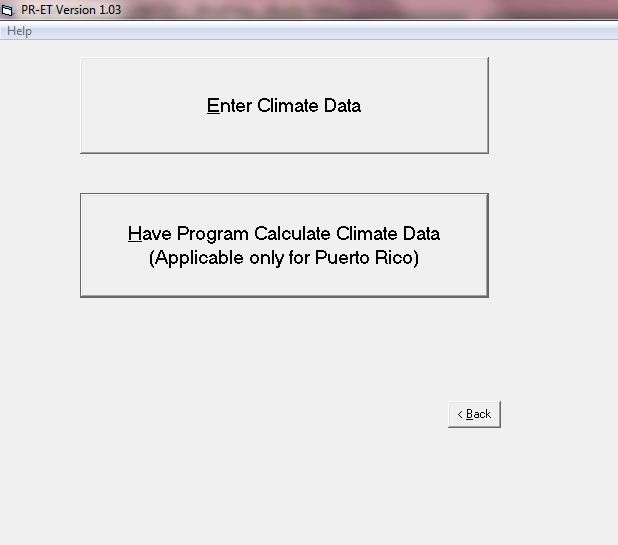
5. Click the icon that says “Have Program Calculate Climate Data (Applicable only for Puerto Rico)”.
6. Click on the appropriate NOAA Climate Division. For example, Juana Diaz, PR, is in Climate Division 2.

7. The next page will give you the results of the long-term monthly weather parameters for your site. If you like you can save the data to a text file.

If you have any questions, contact me at eric.harmsen@upr.edu

Eric

DISCLAIMER: The information is provided “as is”. The authors and publishers of this information disclaim any loss or liability, either directly or indirectly as a consequence of applying the information provided herein, or in regard to the use and application of said information. No guarantee is given, either expressed or implied, in regard to the accuracy, or acceptability of the information.

Excellent Online Resource for Hydraulic/Hydrologic Calculations

VLab: An excellent free Online Resource for Hydraulics/Hydrologic Calculations: http://onlinecalc.sdsu.edu/. Thank you to Dr. Victor Miguel Ponce for your contribution to an Open Source web!

Some irrigation discussion groups you may want to consider subscribing to

Here are four irrigation discussion groups you may want to consider subscribing to. I have been a member of Irr-L for years and have found it invaluable. The information below came from the following website: http://www.trickle-l.com/new/onthenet/

There are four distinct irrigation discussion groups: Irrigation-L, Trickle-L, Salinity-L and SoWaCS.

The purpose of Irrigation-L is to cover technical aspects of irrigation like design, hydraulics, and system layouts. It is also open for topics like irrigation management, socio-cultural, political and economic questions relevant to irrigation.

Trickle-L focuses on all aspects of drip irrigation technology that is sometimes referred to as Microirrigation.

Salinity-L discusses the management practices of saline soils along with more detailed discussions of salt movement in the soil and crop salt tolerance.

SoWaCS or Soil Water Content Sensors is a discussion list which obviously focuses on methods and techniques used to measure soil water content and soil water potential.

All of the above discussion groups are operated by a listserver. A listserver automatically distributes an e-mail message from one member of the list to all other members on the list. When you subscribe to a list, your name and e-mail address is automatically added to it. To subscribe to any of the four lists above, send in the E-mail message (without the quotes), “subscribe (name of list) your name to the following addresses:

For IRRIGATION-L: LISTSERV@listserv.gmd.de (or if this doesn’t work use LISTSERV@listserv.dfn.de)
TRICKLE-L : http://list.vi-dev.com/listinfo/trickle-l
For Salinity-L: LISTSERV@crcvms.unl.edu
For SoWaCs: Majordomo@aqua.ccwr.ac.za

When you subscribe using one of the above email addresses, put SUSCRIBE ###-L (where ### is IRRIGATION or TRICKLE or Salininty or SoWaCs) and YOUR NAME in the subject line, with of course YOUR NAME being your own name.

Eric

The Information Generation (reblog)

The Information Generation – Faster than the Speed of Light Blogsite

I recommend checking out the above blog. Where do you fall in the transition between the analogue and digital ages?

Eric

Thousands Enroll in Stanford Engineering’s Online Courses (reblog)

Free courses!  Very cool!

TEDxPSU – Michael Mann – A Look Into Our Climate: Past To Present To Future

Report on Calibration of Remotely Sensed Solar Radiation Product in Puerto Rico is now available

Report on Calibration of Remotely Sensed Solar Radiation Product in Puerto Rico is now available

Some Irrigation Photos from the University of Puerto Rico – Mayaguez Campus

Photos from my TMAG 4035 Soil and Water Management Course, Spring 2011. The photos show the students installing a drip irrigation system in the Finca Alzamora on the campus of the University of Puerto Rico, Mayaguez, Puerto Rico.

Click Here

GOES-Puerto Rico Water and Energy Balance (GOES-PRWEB) 2010 Results. UPDATED WITH MORE IMAGES.

GOES-Puerto Rico Water and Energy Balance (GOES-PRWEB) 2010 results: http://wp.me/P1s0De-9j

The page now includes many more images for 2010. In addition to the water balance components, the following images are provided:

Transient Variables/Parameters
Air temperature, minimum air temperature, maximum air temperature, effective surface temperature, relative humidity, wind speed, saturated vapor pressure, actual vapor pressure, solar radiation, aerodynamic resistance (Ra), surface resistance (Rs), soil moisture, crop coefficient (Kc), crop stress factor (Ks), net radiation, latent heat flux and sensible heat flux.

Non-transient Parameters:
Surface elevation, Percent sand, silt and clay, field capacity, wilting point, land use/land cover, zero plane displacement and surface roughness, and albedo.