Solar Radiation

Solar projects continue in rural Haiti
Solar projects continue in rural Haiti

Pragwater.com is proud to support the design of solar radiation projects in Haiti.
CLICK HERE to download hourly or daily integrated solar radiation data for Haiti.
Harnessing nature’s solar cells
MIT researcher Andreas Mershin has a vision that within a few years, people in remote villages in the developing world may be able to make their own solar panels, at low cost, using otherwise worthless agricultural waste as their raw material.
Impacts of Land Cover/Land Use Changes in Coastal Tropical Regions under a Changing Environment in Northeast Puerto Rico
Coastal Urban Environmental Research Group (CUERG)
CUERG is a part of the NOAA-Cooperative Remote Sensing Science and Technology Center (NOAA-CREST) at the City College of New York.
CUERG has studied Impacts of Land Cover/Land Use Changes in Coastal Tropical Regions under a Changing Environment in northeast Puerto Rico
Research papers from the group can be found here.

New Book Announcement: Management of Drip/Trickle or Micro Irrigation – Forthcoming Spring 2012
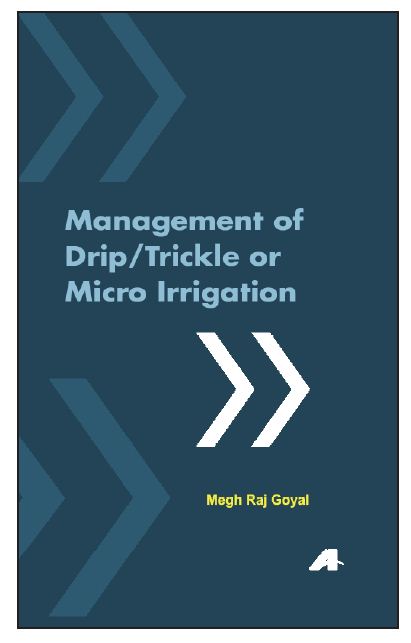
Management of Drip/Trickle or Micro Irrigation
By Megh R. Goyal, PhD, Professor in Agricultural and Biomedical Engineering, University of Puerto Rico
http://www.appleacademicpress.com
This important book—the only complete, one-stop manual on microirrigation worldwide—offers knowledge and techniques necessary to develop and manage a drip/trickle or micro irrigation system. The simplicity of the contents facilitates a technician to develop an effective micro irrigation system. Management of Drip/Trickle or Micro Irrigation includes the basic considerations relating to soil-water-plant interactions, with topics such as methods for soil moisture measurement; evapotranspiration; irrigation systems; tensiometer use and installation; principles of drip/ micro/trickle irrigation; filtration systems; automation; chloration; service and maintenance; design of drip irrigation and lateral lines; the evaluation of uniformity of application; and an economical analysis for selecting irrigation technology.
On Reading Old Things
On Reading Old Things is a great article by Jacquelyn Gill. All graduate students should read this article. At the beginning of this semester I assigned a reading by Gautier et al.(1980) and remember feeling a little embarrassed that the article, which is about satellite technology, was so old. Despite its age, however, the article is excellent and forms the basis of the satellite technology which we use to obtain the current hourly and daily solar radiation in the northern Caribbean. I could list other examples of old articles that are foundational and which should be read by anybody working in those fields. Gill mentions, and I have personally observed, that some journal reviewers sometime pressure authors to use recently published references and discourage older ones. Another practice that I have observed is that a journal will require that at least three references in the paper be from their journal. The reason for this of course is to jack up the rating of their journal, since they are rated on the number of times that their articles are cited. Anyhow, I highly recommend that you read On Reading Old Things.

From Gautier, C., G. R. Diak, and S. Masse, 1980: A simple physical model to estimate incident solar radiation at the surface from GOES satellite data. J. Appl. Meteor., 19, 1007–1012.
CROP WATER USE ( HARGREAVES ET EQUATION) WOLFRAM ALPHA WIDGET
CROP WATER USE ( HARGREAVES ET EQUATION) NEW WOLFRAM ALPHA WIDGET. Reference: Hargreaves, G. H. and Z. A. Samani, Reference Crop Evapotranspiration from Temperature. Appl. Eng. Agric., ASAE. 1(2). 1985,. pp.96-99.
Widget Application: Suppose you want to schedule irrigation by replacing the water evapotranspired by your crop each day. 1. Click on the appropriate link to get yesterdays solar radiation for your location: Puerto Rico or Northern Caribbean, 2. Check the internet for the average daily air temperature at your location (average = (minimum + maximum)/2), 3. Get the appropriate crop coefficient for your crop from this link, and 4. Finally, enter solar radiation, air temperature and crop coefficient into the widget to estimate ET. Multiply ET x acres x 1069.0663 to get the number of gallons of water you need to apply to your field.


 PRAGWATER

