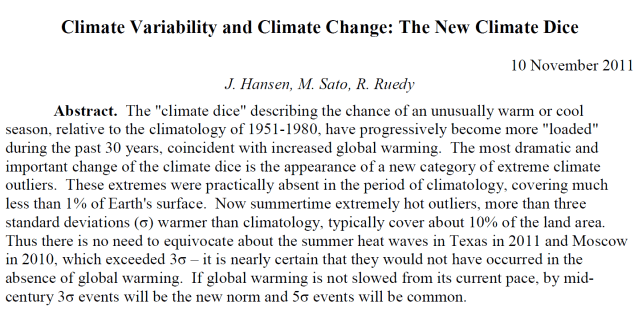
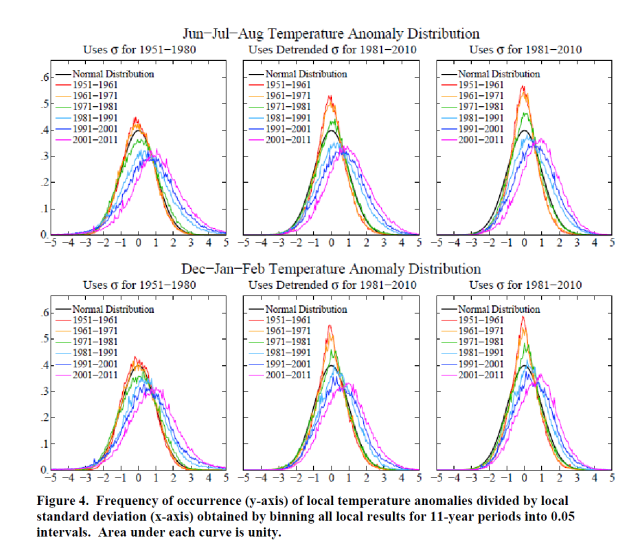
Climate Variability and Climate Change: The New Climate Dice

This peer-reviewed paper, which has been submitted to a leading scientific journal and made available to Time.com prior to publication, can be downloaded at the following website: http://ecocentric.blogs.time.com/2012/05/10/global-warming-an-exclusive-look-at-james-hansens-scary-new-math/#ixzz1z1Yv5dJP

[Notice that the date on the New York Times article is May 10, 2012 and the date on the journal article is November 10, 2011.  Given humanity’s urgent need for scientific information, we need to speed up the scientific journal publication process, without compromising the quality of the publications.]
Global Warming: An Exclusive Look at James Hansen’s Scary New Math

A new analysis by the NASA climatologist for the first time ties specific weather events to human-induced climate change

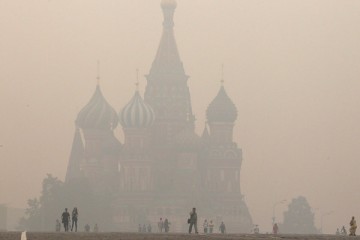
Alexander Demianchuk / Reuters
Lone tourists walk along Red Square in heavy smog, caused by peat fires in nearby forests, in central Moscow, Aug. 9, 2010.

TALLER: TRANSICION FINCAS CONVENCIONALES A ORGANICAS

CLICK ANUNCIO PARA MÁS INFORMACIÓN

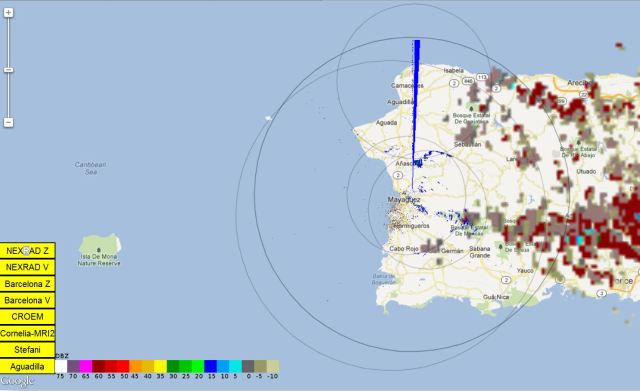
UPRM CASA RADAR

UPRM CASA RADARS

This is very cool!  There are eight radars superimposed on this plot

“OCCUPY” THE OUTDATED PUBLISHING MODEL FOR SCIENTIFIC JOURNALS

The problem with publishing scientific articles with the traditional publishing companies is

1. Usually, the Federal government (e.g., NSF, NASA, NIH, etc.) pay for the research.
2. The University pays the salary of the researcher who writes the paper.
3. The researcher submits the paper to the publishing company and the Science Editor (usually a volunteer) finds reviewers (volunteers) to review the paper.
4. The Researcher pays the publishing company to publish his or her paper.
5. The University pays the publishing company for a subscription to access the journal article.
6. The taxpayers that paid for the research cannot access the journal article without paying for an expensive subscription.

Does something appear to be wrong with this picture?  Why do we need the publishing company??  Other than the production of hardcopy books, they really are not necessary.  And the Direct Publishing/Print on Demand movement has shown that it is possible to publish hard copy documents and make them available to a mass market.

The following links provide detailed information related to the problems with the old publishing model and ideas for moving toward more open access.

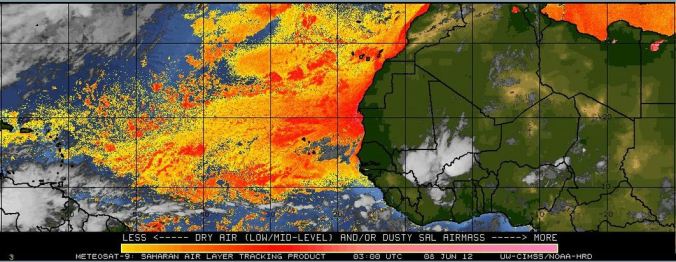
meteosat-9: saharan air layer tracking product

meteosat-9: saharan air layer tracking product

Animation: http://tropic.ssec.wisc.edu/real-time/sal/splitE/movies/splitE5.html

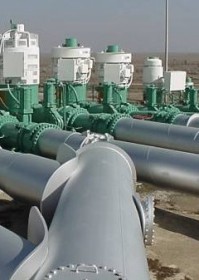
A Closer Look at Watts and Joules, Power and Energy

A Closer Look at Watts and Joules, Power and Energy

This article makes a good point about the distinction between energy and power.  We really don’t want energy (all the wind and sunshine around us represents energy), what we want is power.


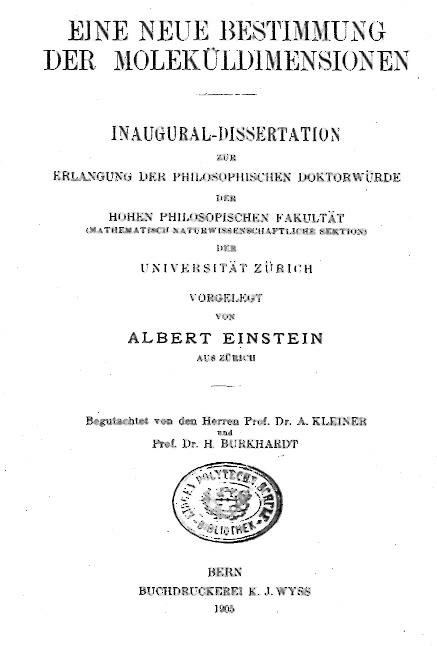
Graduation Time – Remembering Einstein’s Dissertation

Graduation Time – Remembering Einstein’s Dissertation

This is for my graduate student who is defending her Ph.D. dissertation this summer.  I always tell my students that they don’t need to write hundreds of pages for their thesis/dissertations and remind them that Albert Einstein’s dissertation was only 24 pages!!  This article also includes some other interesting trivia about Albert Einstein, and will make the most self-doubting graduate student feel better about themselves.

10 Scientific Laws and Theories You Really Should Know

10 Scientific Laws and Theories You Really Should Know

Irrigation System Evaluation Short Courses

Irrigation System Evaluation Short Courses

Cal Poly Irrigation Training and Research Center classes for Irrigation System Evaluation.

Sponsored by the California Department of Water Resources
Online Portion:  Now Open
Hands-On Class 1: June 18-20, 2012 
Hands-On Class 2: June 20-22, 2012