Replacement Weather Satellite for GOES East

Replacement Weather Satellite for GOES East

This is bad news for the Caribbean Region.  And this is very bad news for those of you that regularly download solar radiation data from pragwater.com or rely on results from GOES-PRWEB.  The National Oceanic and Atmospheric Administration (NOAA) confirmed Monday that GOES-13 has been placed in stand-by mode, following increased vibrations, or “noise,” observed in imagery over the past couple of days.  For more information visit http://www.accuweather.com/en/weather-news/key-us-weather-satellite-goes/78844

This post has implications on data from the following pragwater web pages:
https://pragwater.com/solar-radiation-data-for-pr-dr-and-haiti/
https://pragwater.com/goes-puerto-rico-water-and-energy-balance-goes-web-algorithm/

This composite satellite image from Sunday shows a lack of data from GOES-13 over the east coast of the U.S. (CIMSS Satellite Blog)

Course offerings this semester at UPRM: Ag Hydrology and Agroclimatology (TMAG)

I will be offering the following two courses this semester at UPR-Mayaguez. Please click links for more information.

TMAG 4038 Agricultural Hydrology

TMAG 5017 Agroclimatology

DAILY, MONTHLY AND ANNUAL MAPS FOR 23 HYDROCLIMATE VARIABLE FOR PUERTO RICO

DAILY, MONTHLY AND ANNUAL MAPS FOR 23 HYDROCLIMATE VARIABLE FOR PUERTO RICO

Example results: Actual Evapotranspiration for the June 2012 over Puerto Rico.  Units are in millimeters/month.

Solar data available for the northern Caribbean

Solar data available for the northern Caribbean

Daily and hourly data are available for download. The download site also includes images of yesterday’s solar radiation for Puerto Rico (INSOLRICO.JPG) and Hispaniola (INSOLCARB.JPG). Some example data are given below.


Evapotranspiration in Puerto Rico, Parts 1-5 on Youtube

IITF Science Seminar Series
USDA Forest Service International Institute of Tropical Forestry (IITF)

Satellite-Based Daily Evapotranpiration Estimation in Puerto Rico
Presented by Eric Harmsen

Part 1 Part 2 Part 3 Part 4 Part 5

Since this presentation was given in June of 2009, we have completed the operational version of the GOES-Puerto Rico Water and Energy Balance algorithm (GOES-PRWEB). For more information click HERE.

Course offerings next semester at UPRM: Ag Hydrology and Agroclimatology

I will be offering the following two courses next semester at UPR-Mayaguez. Please click links for more information.

TMAG 4038 Agricultural Hydrology

TMAG 5017 Agroclimatology

GOES-PUERTO RICO WATER AND ENERGY BALANCE (GOES-PRWEB) IS NOW OPERATIONAL

GOES-PRWEB is finally operational.  I would like to thank my student, Victor Reventos, who made it possible through his Python programming skills.  Here is a link to the results:

http://academic.uprm.edu/hdc/GOES-PRWEB_RESULTS/

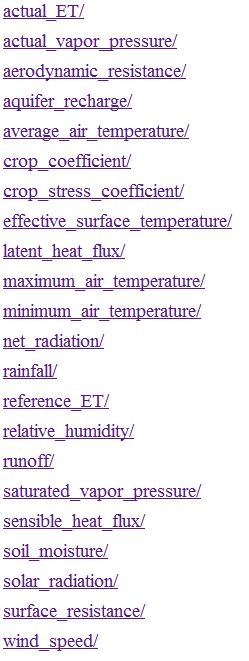
New results will be published daily.  Historical results are available from January 1, 2010. A list of the available output is provided below.

For information on GOES-PRWEB please visit the following link:

https://pragwater.com/goes-puerto-rico-water-and-energy-balance-goes-web-algorithm/

Eric Harmsen

GOES-PRWEB RESULTS


NON-TRANSIENT PARAMETERS


ACKNOWLEDGEMENTS: This research received partial funding from the following sources: NOAA-CREST (grant NA06OAR4810162) and USDA Hatch Project (Hatch-402). Special thanks to Dr. John Mecikalski for providing the solar radiation data, and Alejandra Rojas for providing various GIS maps used in this research.

DISCLAIMER: The information is provided “as is”. The authors and publishers of this information disclaim any loss or liability, either directly or indirectly as a consequence of applying the information provided herein, or in regard to the use and application of said information. No guarantee is given, either expressed or implied, in regard to the accuracy, or acceptability of the information.

Solar projects continue in rural Haiti

Solar projects continue in rural Haiti

Pragwater.com is proud to support the design of solar radiation projects in Haiti.

CLICK HERE to download hourly or daily integrated solar radiation data for Haiti.

On Reading Old Things

On Reading Old Things is a great article by Jacquelyn Gill. All graduate students should read this article. At the beginning of this semester I assigned a reading by Gautier et al.(1980) and remember feeling a little embarrassed that the article, which is about satellite technology, was so old. Despite its age, however, the article is excellent and forms the basis of the satellite technology which we use to obtain the current hourly and daily solar radiation in the northern Caribbean. I could list other examples of old articles that are foundational and which should be read by anybody working in those fields. Gill mentions, and I have personally observed, that some journal reviewers sometime pressure authors to use recently published references and discourage older ones. Another practice that I have observed is that a journal will require that at least three references in the paper be from their journal. The reason for this of course is to jack up the rating of their journal, since they are rated on the number of times that their articles are cited. Anyhow, I highly recommend that you read On Reading Old Things.

From Gautier, C., G. R. Diak, and S. Masse, 1980: A simple physical model to estimate incident solar radiation at the surface from GOES satellite data. J. Appl. Meteor., 19, 1007–1012.

CROP WATER USE ( HARGREAVES ET EQUATION) WOLFRAM ALPHA WIDGET

CROP WATER USE ( HARGREAVES ET EQUATION) NEW WOLFRAM ALPHA WIDGET. Reference: Hargreaves, G. H. and Z. A. Samani, Reference Crop Evapotranspiration from Temperature. Appl. Eng. Agric., ASAE. 1(2). 1985,. pp.96-99.

Widget Application: Suppose you want to schedule irrigation by replacing the water evapotranspired by your crop each day.  1. Click on the appropriate link to get yesterdays solar radiation for your location: Puerto Rico or Northern Caribbean, 2. Check the internet for the average daily air temperature at your location (average = (minimum + maximum)/2),  3. Get the appropriate crop coefficient for your crop from this link, and 4. Finally, enter solar radiation, air temperature and crop coefficient into the widget to estimate ET. Multiply ET x acres x 1069.0663 to get the number of gallons of water you need to apply to your field.