Hydrologic Information and Data for Puerto Rico

Hydrologic Information and Data for Puerto Rico

Additional Information:

GOES-Puerto Rico Water and Energy Balance (GOES-WEB) Algorithm

Hydrology for Puerto Rico

USGS – Island hydrology: Puerto Rico and the U.S. Virgin Islands

Hydrogeology of the Karst of Puerto Rico

HYDROGEOLOGY OF THE PRINCIPAL SPRINGS IN PUERTO

HYDROLOG – Gobierno de Puerto Rico

Tropical cyclones and the flood hydrology of Puerto Rico

2010 Summer Specialty Conference on Tropical Hydrology

Hydrology Puerto Rico

Fortuño presents agricultural platform

Fortuño presents agricultural platform

Do you think it is a good plan?

Common bean production in  Juana Diaz, Puerto Rico

Introducing a farm tech to reduce water and energy needs – hydrogel

Introducing a farm tech to reduce water and energy needs

This is potentially interesting, but like most stuff from private companies, they don’t want people to know how it works.  So we have to trust them!  Seems to me to be a dying paradigm.

Irrigation System Evaluation Short Courses

Irrigation System Evaluation Short Courses

Cal Poly Irrigation Training and Research Center classes for Irrigation System Evaluation.

Sponsored by the California Department of Water Resources
Online Portion:  Now Open
Hands-On Class 1: June 18-20, 2012 
Hands-On Class 2: June 20-22, 2012 

Evapotranspiration in Puerto Rico, Parts 1-5 on Youtube

IITF Science Seminar Series
USDA Forest Service International Institute of Tropical Forestry (IITF)

Satellite-Based Daily Evapotranpiration Estimation in Puerto Rico
Presented by Eric Harmsen

Part 1 Part 2 Part 3 Part 4 Part 5

Since this presentation was given in June of 2009, we have completed the operational version of the GOES-Puerto Rico Water and Energy Balance algorithm (GOES-PRWEB). For more information click HERE.

Course offerings next semester at UPRM: Ag Hydrology and Agroclimatology

I will be offering the following two courses next semester at UPR-Mayaguez. Please click links for more information.

TMAG 4038 Agricultural Hydrology

TMAG 5017 Agroclimatology

WEB-BASED IRRIGATION SCHEDULING TOOL FOR PUERTO RICO

Map_attribution

There are various approaches for scheduling irrigation.  One approach is to supplement rainfall with enough irrigation so that the cumulative rainfall and irrigation, over a specific period of time (e.g., one day, one week, one season),  matches the estimated crop water requirement.

The information on this page will allow you to schedule your irrigation in this manner. Here is how it works:

1. First, and this is the hardest part, create an evapotranspiration crop coefficient (Kc) curve for your crop.  The following link to the Food and Agriculture Organization (FAO) Document No. 56 provides guidance on the construction of a Kc curve: CLICK HERE.  Your Kc curve should look like FAO 56 Figure no. 34 when you are finished. (FYI: Crop coeffiecient curves can also be created using the PRET computer program)

2. Now it gets easier.  Go to the appropriate reference evapotranspion (ETo) map(s) for Puerto Rico and determine the ETo for your location CLICK HERE.  Note, if you are irrigating ever day, then you only need to obtain the ETo for yesterday’s date.  If, however, you are irrigating once per week, for example, then you will need to get the ETo values from the maps for the previous week. In this latter example, you will need to sum the daily values of ETo to obtain a value of the weekly ETo.

3. From your Kc curve, determine a representative value of Kc for the time period of your analysis (e.g., daily or weekly).

4. Estimate the crop water requirement (crop evapotranspiration)  ETc = Kc x ETo.

5. Estimatate the required depth of irrigation:  Irrigation = ET – Rainfall.  If the estimated Irrigation is negative, then you do not need to irrigate.

It is recommended that you measure the rainfall on your farm with a rain gauge, however, if you do not have access to the measured rainfall, you can obtain an estimate of the rainfall (derived from NEXRAD radar) by clicking here.

The irrigation scheduling approach described above is based on various simplifying assumptions (e.g., surface runoff and deep percolation are ignored).  Nevertheless, it will vastly improve your water management if you are not currently using an irrigation scheduling method.    To evaluate your irrigation management, you may want to construct a graph similar to the example provided below.  The graph shows the cumalative depth of  irrigation and ETc plotted with time.  If these two curves stay close together then you are doing a pretty good job of managing your irrigation.

Example of the cumulative irrigation and ET plotted with time for a crop season. The goal of irrigation scheduling is to try to match the applied irrigation with the ET. By the end of the season, the cumulative irrigation should more or less equal the cumulative ET.

The methods used to obtain ETo and rainfall can be obtained at the following website: GOES-Puerto Rico Water and Energy Balance (GOES-WEB) Algorithm

For another method of irrigation scheduling that takes into account soil moisture, see A simple Irrigation Scheduling Spreadsheet Program

DISCLAIMER: The information is provided “as is”. The authors and publishers of this information disclaim any loss or liability, either directly or indirectly as a consequence of applying the information provided herein, or in regard to the use and application of said information. No guarantee is given, either expressed or implied, in regard to the accuracy, or acceptability of the information.

GOES-PUERTO RICO WATER AND ENERGY BALANCE (GOES-PRWEB) IS NOW OPERATIONAL

GOES-PRWEB is finally operational.  I would like to thank my student, Victor Reventos, who made it possible through his Python programming skills.  Here is a link to the results:

http://academic.uprm.edu/hdc/GOES-PRWEB_RESULTS/

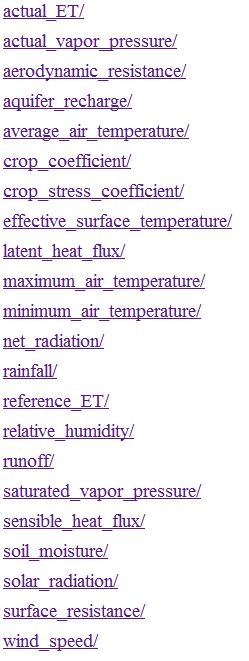
New results will be published daily.  Historical results are available from January 1, 2010. A list of the available output is provided below.

For information on GOES-PRWEB please visit the following link:

https://pragwater.com/goes-puerto-rico-water-and-energy-balance-goes-web-algorithm/

Eric Harmsen

GOES-PRWEB RESULTS


NON-TRANSIENT PARAMETERS


ACKNOWLEDGEMENTS: This research received partial funding from the following sources: NOAA-CREST (grant NA06OAR4810162) and USDA Hatch Project (Hatch-402). Special thanks to Dr. John Mecikalski for providing the solar radiation data, and Alejandra Rojas for providing various GIS maps used in this research.

DISCLAIMER: The information is provided “as is”. The authors and publishers of this information disclaim any loss or liability, either directly or indirectly as a consequence of applying the information provided herein, or in regard to the use and application of said information. No guarantee is given, either expressed or implied, in regard to the accuracy, or acceptability of the information.

GOES-PRWEB TO BECOME OPERATIONAL

Dear Friends

Total estimated actual evapotranspiration for 2010 derived from the GOES-PRWEB algorithm.

I am sending out this “heads up” to let you know that within the next few days the GOES-Puerto Rico Water and Energy Balance (PRWEB) model will become operational.   “Operational” means that the results will appear on the website everyday.  The water and energy balance results, and all other environmental parameters will be published in “near real-time” (i.e., through yesterday’s date).   In other words, if you visit the website on April 2, 2012, for example, the results will be current up through April 1, 2012.  In addition, graphic results will be provided on a daily basis starting from January 1, 2010.

As always, feel free to respond to my posts with questions or comments.

Eric

AGROVISIÓN – Sábado 24 de Marzo