I will be offering the following two courses next semester at UPR-Mayaguez. Please click links for more information.
coffee
Agrovisión, una economía de futuro en Puerto Rico
Agrovisión, una economía de futuro
Sintoniza Radio Isla 1320AM todos los sábados de 1:00 a 2:00 de la tarde y entérate de lo que está pasando hoy en la agricultura de Puerto Rico y su increíble potencial de desarrollo. Con invitados expertos, información para el agricultor, huertos caseros, agricultura urbana, análisis, tecnologías agrícolas de vanguardia, consejos para nuestro público… Te invitamos a poner los pies en tu tierra y ser parte de Agrovisión, una economía de futuro.

WEB-BASED IRRIGATION SCHEDULING TOOL FOR PUERTO RICO
There are various approaches for scheduling irrigation. One approach is to supplement rainfall with enough irrigation so that the cumulative rainfall and irrigation, over a specific period of time (e.g., one day, one week, one season), matches the estimated crop water requirement.
The information on this page will allow you to schedule your irrigation in this manner. Here is how it works:
1. First, and this is the hardest part, create an evapotranspiration crop coefficient (Kc) curve for your crop. The following link to the Food and Agriculture Organization (FAO) Document No. 56 provides guidance on the construction of a Kc curve: CLICK HERE. Your Kc curve should look like FAO 56 Figure no. 34 when you are finished. (FYI: Crop coeffiecient curves can also be created using the PRET computer program)
2. Now it gets easier. Go to the appropriate reference evapotranspion (ETo) map(s) for Puerto Rico and determine the ETo for your location CLICK HERE. Note, if you are irrigating ever day, then you only need to obtain the ETo for yesterday’s date. If, however, you are irrigating once per week, for example, then you will need to get the ETo values from the maps for the previous week. In this latter example, you will need to sum the daily values of ETo to obtain a value of the weekly ETo.
3. From your Kc curve, determine a representative value of Kc for the time period of your analysis (e.g., daily or weekly).
4. Estimate the crop water requirement (crop evapotranspiration) ETc = Kc x ETo.
5. Estimatate the required depth of irrigation: Irrigation = ET – Rainfall. If the estimated Irrigation is negative, then you do not need to irrigate.
It is recommended that you measure the rainfall on your farm with a rain gauge, however, if you do not have access to the measured rainfall, you can obtain an estimate of the rainfall (derived from NEXRAD radar) by clicking here.
The irrigation scheduling approach described above is based on various simplifying assumptions (e.g., surface runoff and deep percolation are ignored). Nevertheless, it will vastly improve your water management if you are not currently using an irrigation scheduling method. To evaluate your irrigation management, you may want to construct a graph similar to the example provided below. The graph shows the cumalative depth of irrigation and ETc plotted with time. If these two curves stay close together then you are doing a pretty good job of managing your irrigation.

Example of the cumulative irrigation and ET plotted with time for a crop season. The goal of irrigation scheduling is to try to match the applied irrigation with the ET. By the end of the season, the cumulative irrigation should more or less equal the cumulative ET.
The methods used to obtain ETo and rainfall can be obtained at the following website: GOES-Puerto Rico Water and Energy Balance (GOES-WEB) Algorithm
For another method of irrigation scheduling that takes into account soil moisture, see A simple Irrigation Scheduling Spreadsheet Program
DISCLAIMER: The information is provided “as is”. The authors and publishers of this information disclaim any loss or liability, either directly or indirectly as a consequence of applying the information provided herein, or in regard to the use and application of said information. No guarantee is given, either expressed or implied, in regard to the accuracy, or acceptability of the information.
AGROVISIÓN – Sábado 24 de Marzo

New Book Announcement: Management of Drip/Trickle or Micro Irrigation – Forthcoming Spring 2012
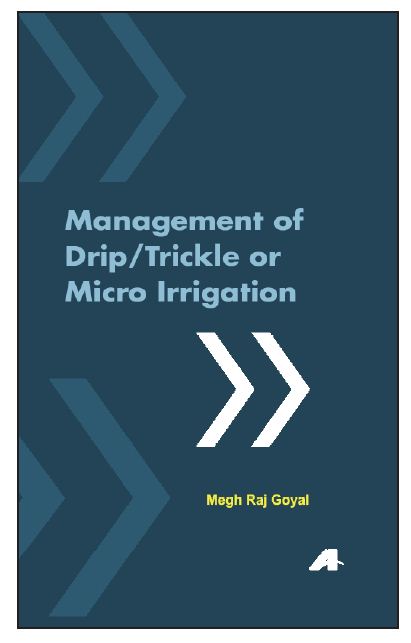
Management of Drip/Trickle or Micro Irrigation
By Megh R. Goyal, PhD, Professor in Agricultural and Biomedical Engineering, University of Puerto Rico
http://www.appleacademicpress.com
This important book—the only complete, one-stop manual on microirrigation worldwide—offers knowledge and techniques necessary to develop and manage a drip/trickle or micro irrigation system. The simplicity of the contents facilitates a technician to develop an effective micro irrigation system. Management of Drip/Trickle or Micro Irrigation includes the basic considerations relating to soil-water-plant interactions, with topics such as methods for soil moisture measurement; evapotranspiration; irrigation systems; tensiometer use and installation; principles of drip/ micro/trickle irrigation; filtration systems; automation; chloration; service and maintenance; design of drip irrigation and lateral lines; the evaluation of uniformity of application; and an economical analysis for selecting irrigation technology.
New Start up in Puerto Rico: Fides HIGH TECH
New Start up in Puerto Rico: Fides HIGH TECH
Fides High Tech is a start-up company based in Puerto Rico dedicated to provide technology solutions to a wide range of markets. Founded by ten professionals in the engineering and technology fields, Fides High Tech has the advantage to be able to provide expertise in a wide range of industries and different type of technologies. Our vision is to become leaders and pioneers who empower markets and communities towards technology that was previously unattainable, promoting the advancement and progress of Puerto Rico, the Caribbean and the world.
Fides is defined as: promise, assurance, word of honor, engagement.
Frente Rescate Agrícola – Dile NO a la pérdida de terrenos agrícolas
Frente Rescate Agrícola – Dile NO a la pérdida de terrenos agrícolas

El Frente de Rescate Agrícola (FRA) es un movimiento de base popular que agrupa a diversas organizaciones civiles comprometidas con la agricultura y con un desarrollo sustentable del país. Este frente surge como propuesta a la preocupación colectiva de la pérdida desmedida de los terrenos agrícolas de Puerto Rico a causa de un desarrollo desenfrenado en beneficio de un supuesto progreso. El FRA se estará manifestando de diversas formas educando al pueblo y proponiendo alternativas para la preservación de los terrenos y para el progreso sostenible del país. Hemos llegado al punto donde la pérdida de una pulgada adicional de terrenos agrícolas representa una amenaza al sustento alimentario de las presentes y futuras generaciones.
Es momento ya de considerar la agricultura y los recursos naturales como pilar en el desarrollo del país. La crisis alimentaria que enfrenta Puerto Rico y agravada con la pérdida de terrenos agrícolas es un asunto de seguridad nacional y todo aquel que atente en contra de los terrenos está cometiendo una agresión directa al pueblo puertorriqueño.
Powered By Caffeine: A New Technology To Extract Energy From Coffee

Bill Gates to world: Spend more on farming

pragwater.com is not just for Puerto Rico
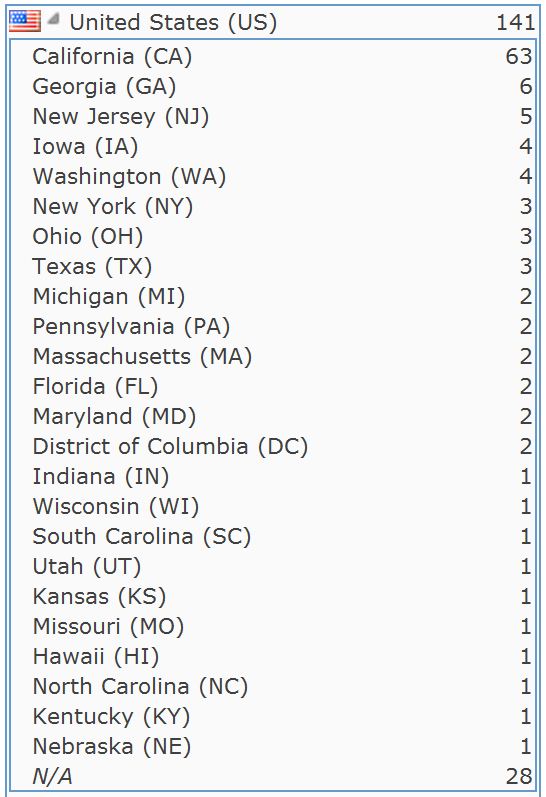
Two weeks ago, pragwater.com started using a free online service called ClusterMaps. We were happy to learn that pragwater.com has received visits from people all over the world, 27 countries in all. Here is the breakdown:

 PRAGWATER