All graduate students should read this article.

Jacquelyn Gill's avatarThe Contemplative Mammoth

This post is part of the Diversity in Science Blog Carnival on Imposter Syndrome, hosted by Scicurious over at Neurotic Physiology.

When I started graduate school at the University of Wisconsin, I felt like an imposter. I thought that all of my fellow grad students were more together, had more basic science training (I never took calculus, intro bio or chemistry as an undergrad), were more articulate, less doubtful. I felt like I’d somehow fooled everyone into thinking I was qualified to get into graduate school, and couldn’t shake the anxiety that someone would ultimately figure out the error. When something good would happen– a grant, or an award– I subconsciously chalked it up to luck, rather than merit. It wasn’t until I was a year or two into my PhD that I learned that these feelings have a name: “imposter syndrome.” Imposter syndrome is incredibly prevalent amongst…

View original post 851 more words

Must-Read: Tom Friedman On Climate Change And ‘The Other Arab Spring’

Must-Read: Tom Friedman On Climate Change And ‘The Other Arab Spring’


NOAA concluded in 2011 that “human-caused climate change [is now] a major factor in more frequent Mediterranean droughts.” Reds and oranges highlight lands around the Mediterranean that experienced significantly drier winters during 1971-2010 than the comparison period of 1902-2010.

What A Wonderful World With David Attenborough — BBC One

Denmark Passes Legislation: 100% Renewable Energy by 2050!

Denmark Passes Legislation: 100% Renewable Energy by 2050!
from sustainablebusiness.com

World Meteorological Organization shortens winter

Bob Berwyn's avatarSummit County Citizens Voice

New parameter better match current climate reality, scientists say

By Bob Berwyn

SUMMIT COUNTY — After evaluating the latest satellite data from the past few months, the World Meteorological Organization announced April 1 that, starting this year, the official winter season will be shortened by one month, two weeks at either end.

A warming global climate, especially in the Arctic, requires the change in order to keep the seasons in synch with climatological realities, said Manny Fairweather, lead long-range climate analyst for the Geneva-based group.

Instead of beginning Dec. 21, winter will officially start Jan. 6, and instead of ending March 21, it will end two weeks earlier, on March 7.

“It just doesn’t make sense for winter to last for three months anymore,” Fairweather said at an April 1 press conference. “The reality is that we just aren’t seeing winter conditions in December, so we’ve decided to delay the…

View original post 148 more words

Summit Voice: Most-viewed and week in review

Wow, check out the temperature anomalies in the far north!

Bob Berwyn's avatarSummit County Citizens Voice

Climate, avalanches and … cattle genetics?

By Summit Voice

SUMMIT COUNTY — Global warming stayed at the top of the charts, but just barely. By late Sunday night, a science story on the genetic origins of domestic cattle was within a few page views and steadily climbing, thanks to a link from Fark.com. Stories on a pair of unfortunate backcountry skier deaths during the weekend, and coverage of the Lower North Fork Fire in Jefferson County rounded out this week’s most-viewed list. Click the headlines to read the stories and pass them along on your own favorite network with the share buttons at the end of each story.

View original post 187 more words

Calle 13 – Latinoamérica

Monthly Average Solar Radiation Images Available for Puerto Rico

Monthly average solar radiation images for Puerto Rico can be downloaded at the following link:
http://academic.uprm.edu/hdc/GOES-PRWEB_MONTHLY_RESULTS/solar_radiation/

The images includes 26 months of data starting in January 2010.  Other atmospheric/hydrologic data images are also available at the following link:

https://pragwater.com/goes-puerto-rico-water-and-energy-balance-goes-web-algorithm/

GOES-PUERTO RICO WATER AND ENERGY BALANCE: MONTHLY AVERAGES AND TOTALS NOW AVAILABLE

This week we announced that GOES-PRWEB is operational.  Daily data since January 1, 2010 is now available at the link:
http://academic.uprm.edu/hdc/GOES-PRWEB_RESULTS/

Today, 26 months of monthly averages and totals were uploaded to the link: http://academic.uprm.edu/hdc/GOES-PRWEB_MONTHLY_RESULTS/

Annual averages and totals will be uploaded next week.

___________________________________

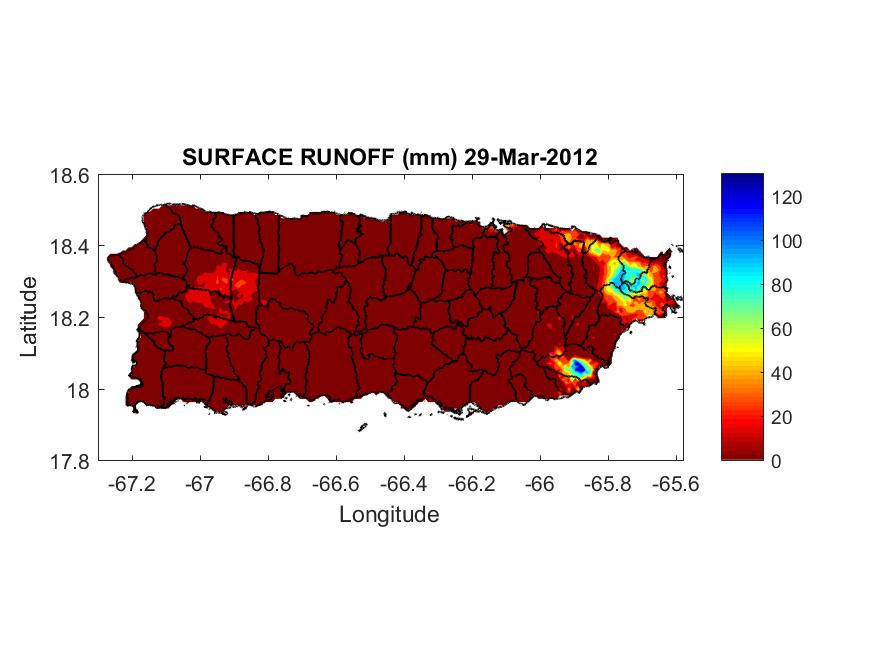
Incidently, I noticed an interesting result in yesterdays data.  In the area of the Arecibo Space Observatory, there was approximately 300 mm of rainfall and almost as much surface runoff.  This was a really huge storm, 300 mm is around 12 inches!! Over 12 inches of rain was measured at the USGS Station 50028000 RIO TANAMA NR UTUADO.  The precipitation, discharge and gauge height plots from the USGS website are given below.

WEB-BASED IRRIGATION SCHEDULING TOOL FOR PUERTO RICO

Map_attribution

There are various approaches for scheduling irrigation.  One approach is to supplement rainfall with enough irrigation so that the cumulative rainfall and irrigation, over a specific period of time (e.g., one day, one week, one season),  matches the estimated crop water requirement.

The information on this page will allow you to schedule your irrigation in this manner. Here is how it works:

1. First, and this is the hardest part, create an evapotranspiration crop coefficient (Kc) curve for your crop.  The following link to the Food and Agriculture Organization (FAO) Document No. 56 provides guidance on the construction of a Kc curve: CLICK HERE.  Your Kc curve should look like FAO 56 Figure no. 34 when you are finished. (FYI: Crop coeffiecient curves can also be created using the PRET computer program)

2. Now it gets easier.  Go to the appropriate reference evapotranspion (ETo) map(s) for Puerto Rico and determine the ETo for your location CLICK HERE.  Note, if you are irrigating ever day, then you only need to obtain the ETo for yesterday’s date.  If, however, you are irrigating once per week, for example, then you will need to get the ETo values from the maps for the previous week. In this latter example, you will need to sum the daily values of ETo to obtain a value of the weekly ETo.

3. From your Kc curve, determine a representative value of Kc for the time period of your analysis (e.g., daily or weekly).

4. Estimate the crop water requirement (crop evapotranspiration)  ETc = Kc x ETo.

5. Estimatate the required depth of irrigation:  Irrigation = ET – Rainfall.  If the estimated Irrigation is negative, then you do not need to irrigate.

It is recommended that you measure the rainfall on your farm with a rain gauge, however, if you do not have access to the measured rainfall, you can obtain an estimate of the rainfall (derived from NEXRAD radar) by clicking here.

The irrigation scheduling approach described above is based on various simplifying assumptions (e.g., surface runoff and deep percolation are ignored).  Nevertheless, it will vastly improve your water management if you are not currently using an irrigation scheduling method.    To evaluate your irrigation management, you may want to construct a graph similar to the example provided below.  The graph shows the cumalative depth of  irrigation and ETc plotted with time.  If these two curves stay close together then you are doing a pretty good job of managing your irrigation.

Example of the cumulative irrigation and ET plotted with time for a crop season. The goal of irrigation scheduling is to try to match the applied irrigation with the ET. By the end of the season, the cumulative irrigation should more or less equal the cumulative ET.

The methods used to obtain ETo and rainfall can be obtained at the following website: GOES-Puerto Rico Water and Energy Balance (GOES-WEB) Algorithm

For another method of irrigation scheduling that takes into account soil moisture, see A simple Irrigation Scheduling Spreadsheet Program

DISCLAIMER: The information is provided “as is”. The authors and publishers of this information disclaim any loss or liability, either directly or indirectly as a consequence of applying the information provided herein, or in regard to the use and application of said information. No guarantee is given, either expressed or implied, in regard to the accuracy, or acceptability of the information.