CROP WATER USE ( HARGREAVES ET EQUATION) WOLFRAM ALPHA WIDGET

CROP WATER USE ( HARGREAVES ET EQUATION) NEW WOLFRAM ALPHA WIDGET. Reference: Hargreaves, G. H. and Z. A. Samani, Reference Crop Evapotranspiration from Temperature. Appl. Eng. Agric., ASAE. 1(2). 1985,. pp.96-99.

Widget Application: Suppose you want to schedule irrigation by replacing the water evapotranspired by your crop each day.  1. Click on the appropriate link to get yesterdays solar radiation for your location: Puerto Rico or Northern Caribbean, 2. Check the internet for the average daily air temperature at your location (average = (minimum + maximum)/2),  3. Get the appropriate crop coefficient for your crop from this link, and 4. Finally, enter solar radiation, air temperature and crop coefficient into the widget to estimate ET. Multiply ET x acres x 1069.0663 to get the number of gallons of water you need to apply to your field.
NASA: Human Activity, Not Solar Activity, Drives Global Warming and Returning to 350 ppm Is Needed to Stop It

NASA: Human Activity, Not Solar Activity, Drives Global Warming and Returning to 350 ppm Is Needed to Stop It

See also: http://www.giss.nasa.gov/research/briefs/hansen_16/

MIT researcher discovers way to make solar panels from plants

MIT researcher discovers way to make solar panels from plants

Explaining climate change science & rebutting global warming misinformation

Explaining climate change science & rebutting global warming misinformation

Do the arguments of the global warming skeptics hold water scientifically? The above website evaluates the validity of many of the common arguments made by global warming skeptics based on the scientific literature.

Bicentennial cycle of deep cooling starting in 2014 – another little ice age in 2055±11 years

Bicentennial cycle of deep cooling starting in 2014 – another little ice age in 2055±11 years

Interesting but odd assumptions. The article states:

“From early 90s we observe bicentennial decrease in both the TSI [total solar irradiance] and the portion of its energy absorbed by the Earth. The Earth as a planet will henceforward have negative balance in the energy budget which will result in the temperature drop in approximately 2014. Due to increase of albedo and decrease of the greenhouse gases atmospheric concentration the absorbed portion of solar energy and the influence of the greenhouse effect will additionally decline.”

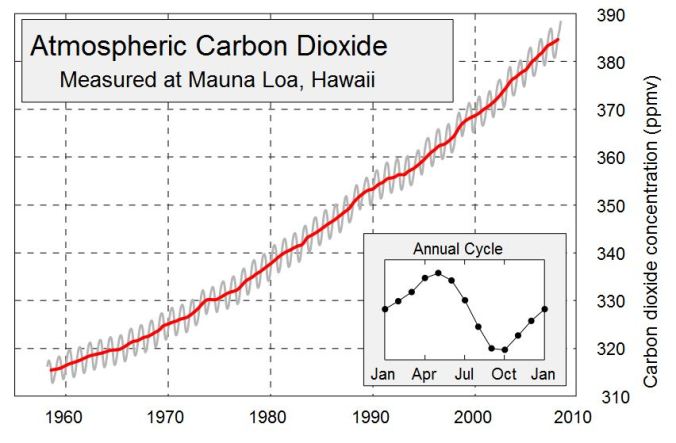
I didn’t know that the planetary albedo was going to go up and the atmospheric CO2 concentration was going to go down during this century! The latest plot of CO2 from Mauna Loa indicates that the atmospheric concentration is still on an upward trend (see image below). This trend may very well continue with rapid economic development in countries like China and India. Whether planetary albedo will go up or down seems to be in debate. In any case it would be important for climate change models to incorporate the reduction in the predicted total solar irradiance. Are there any studies that have done this?


Image is from http://en.wikipedia.org/wiki/Carbon_dioxide

Probing the Role of the Sun In an Era of Global Warming

Probing the Role of the Sun In an Era of Global Warming.
Yale environement360 Opinion, Analysis, Reporting & Debate
Be sure to check out the comments.


Source of photograph: Solar Feeds News and Commentary

PUERTO RICO SEISMIC NETWORK/RED SÍSMICA DE PUERTO RICO

PUERTO RICO SEISMIC NETWORK/RED SÍSMICA DE PUERTO RICO

Available in English
Disponible en español

Vision
To be the leading center in the monitoring, warning and information, research and education of earthquakes and tsunamis in the Caribbean.

Mission
Inform in a reliable and timely manner the generation and effects of earthquakes and tsunamis for Puerto Rico and Virgin Islands.

Excellent Interactive MATLAB Tutorial


Here is an excellent interactive MATLAB tutorial. I recommend it!

CLIMATE IMPACT EQUITY LENS (CIEL) – CLIMATE CHANGE GETS PERSONAL

CLIMATE IMPACT EQUITY LENS (CIEL) – CLIMATE CHANGE GETS PERSONAL
Spanish Version

The Climate Impact Equity Lens (CIEL) is a new tool for comparing the net climate impacts felt by diverse individuals around the world, and for tracking individual impacts over time. CIEL demonstrates that climate change will affect each person differently.

At present, very little is being done to prevent dangerous climate change. Some people are already experiencing damages from changing temperatures and weather patterns, and from sea-level rise – but everyone is enjoying the “benefit” of not paying for more ambitious emission reductions. Looking only at today’s impacts, most – but not all – of us are net winners (saving more from inaction than we lose from climate damages). Over the course of this century, net losers will become more common; in the next century, it will be hard to find people who still benefit from inaction.

CIEL provides a graphic display of changes over time in each individual’s net economic impact from climate change. You can download several CIEL publications and a tool that allows you to input individual characteristics to estimate the personal impact of climate change.

The Climate Impact Equity Lens (CIEL) is a new tool for comparing the net climate impacts felt by diverse individuals around the world, and for tracking individual impacts over time. CIEL demonstrates that climate change will affect each person differently.

(Excerpted from CIEL website, 2011, Stockholm Environment Institute, 11 Curtis Avenue, Somerville, MA 02145, USA. Phone: 1(617) 627-3786. Email: CIEL@sei-us.org)

Solar Energy

Really great educational video. Thanks for sharing Harry @Dulaney_Solar