New Book Announcement: Management of Drip/Trickle or Micro Irrigation – Forthcoming Spring 2012

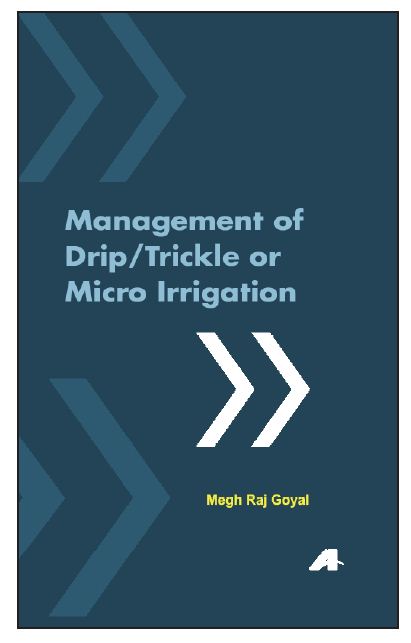
Management of Drip/Trickle or Micro Irrigation
By Megh R. Goyal, PhD, Professor in Agricultural and Biomedical Engineering, University of Puerto Rico

http://www.appleacademicpress.com

This important book—the only complete, one-stop manual on microirrigation worldwide—offers knowledge and techniques necessary to develop and manage a drip/trickle or micro irrigation system. The simplicity of the contents facilitates a technician to develop an effective micro irrigation system. Management of Drip/Trickle or Micro Irrigation includes the basic considerations relating to soil-water-plant interactions, with topics such as methods for soil moisture measurement; evapotranspiration; irrigation systems; tensiometer use and installation; principles of drip/ micro/trickle irrigation; filtration systems; automation; chloration; service and maintenance; design of drip irrigation and lateral lines; the evaluation of uniformity of application; and an economical analysis for selecting irrigation technology.

Agricultores podrían demandar a la Autoridad de Tierras

Agricultores podrían demandar a la Autoridad de Tierras

“Le han dado contrato a otras personas a $30 por cuerda cuando nosotros pagábamos $85 por cuerda”, dijo Hernández, quien tiene seis obreros en su finca.

See also: http://frapuertorico.wordpress.com/2012/02/12/en-pie-de-lucha-agricultores-en-el-valle-del-coloso-en-aguada/

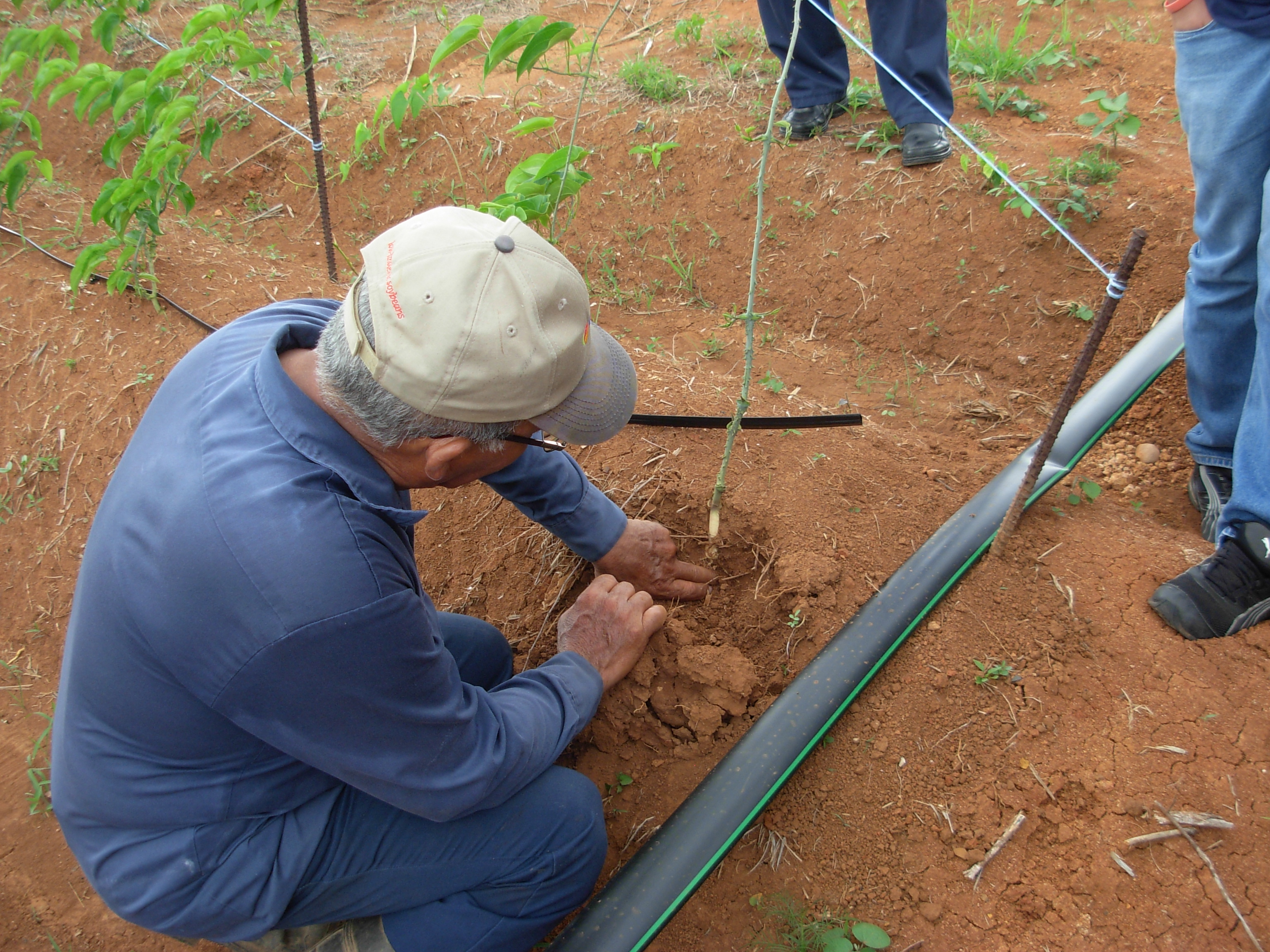
Photos from UPRM Soil and Water Management Class field trip to a farm in the Coloso Valley in 2011.

After Recess: Change the World

Op-Ed
After Recess: Change the World
By NICHOLAS D. KRISTOF
Published: February 4, 2012
A BATTLE between a class of fourth graders and a major movie studio would seem an unequal fight. Changing the world via internet petitions.

Damon Winter/The New York Times
Nicholas D. Kristof

On Reading Old Things

On Reading Old Things is a great article by Jacquelyn Gill. All graduate students should read this article. At the beginning of this semester I assigned a reading by Gautier et al.(1980) and remember feeling a little embarrassed that the article, which is about satellite technology, was so old. Despite its age, however, the article is excellent and forms the basis of the satellite technology which we use to obtain the current hourly and daily solar radiation in the northern Caribbean. I could list other examples of old articles that are foundational and which should be read by anybody working in those fields. Gill mentions, and I have personally observed, that some journal reviewers sometime pressure authors to use recently published references and discourage older ones. Another practice that I have observed is that a journal will require that at least three references in the paper be from their journal. The reason for this of course is to jack up the rating of their journal, since they are rated on the number of times that their articles are cited. Anyhow, I highly recommend that you read On Reading Old Things.

From Gautier, C., G. R. Diak, and S. Masse, 1980: A simple physical model to estimate incident solar radiation at the surface from GOES satellite data. J. Appl. Meteor., 19, 1007–1012.

Puerto Rico divided over energy future

Puerto Rico divided over energy future
Island split over natural gas pipeline and windfarm in move away from oil-based energy generation

guardian.co.uk, Thursday 26 January 2012

Did you know that between 60 and 80% of the food produced in most developing countries is produced by women

Did you know that “…up to 75% of people living in developing countries rely on agriculture for their livelihoods and that over 90% of Africa’s agricultural production comes from small-scale production. Many of these farmers are women, who play a critical role in food and nutrition security and are responsible for growing, buying, selling and cooking the food. Between 60 and 80% of the food produced in most developing countries is produced by women and in sub-Saharan Africa, the figure is between 80 and 90 per cent. Yet less than 2% of land in sub-Saharan Africa is owned by women.”

“Across Africa, farmers are experiencing unpredictable growing seasons, making the age-old art and science of farming a guessing game. It is estimated that by 2050, up to 25% of world food production could be lost as a result of climate change, water scarcity and land degradation. This, combined with an expected population of 9 billion in 2050, paints a frightening picture of what may lie ahead for the next generation.”
Excerpt from GIMAC speaking notes for Mary Robinson President, Mary Robinson Foundation – Climate Justice (MRFCJ)

The Mary Robinson Foundation – Climate Justice (MRFCJ)

Why women are world’s best climate change defense

The Mary Robinson Foundation – Climate Justice (MRFCJ)

The Mary Robinson Foundation – Climate Justice (MRFCJ) is a centre for thought leadership, education and advocacy on the struggle to secure global justice for those many victims of climate change who are usually forgotten – the poor, the disempowered and the marginalised across the world.

See also Why women are world’s best climate change defense

Ethical questions in an Internet Age

Ethical questions in an Internet Age
Ethical questions in online communities & thoughts on principles, based on the Baha’i writings, to consider.

Take this online course for free from udemy

Frente Rescate Agrícola – Dile NO a la pérdida de terrenos agrícolas

Frente Rescate Agrícola – Dile NO a la pérdida de terrenos agrícolas

El Frente de Rescate Agrícola (FRA) es un movimiento de base popular que agrupa a diversas organizaciones civiles comprometidas con la agricultura y con un desarrollo sustentable del país. Este frente surge como propuesta a la preocupación colectiva de la pérdida desmedida de los terrenos agrícolas de Puerto Rico a causa de un desarrollo desenfrenado en beneficio de un supuesto progreso. El FRA se estará manifestando de diversas formas educando al pueblo y proponiendo alternativas para la preservación de los terrenos y para el progreso sostenible del país. Hemos llegado al punto donde la pérdida de una pulgada adicional de terrenos agrícolas representa una amenaza al sustento alimentario de las presentes y futuras generaciones.

Es momento ya de considerar la agricultura y los recursos naturales como pilar en el desarrollo del país. La crisis alimentaria que enfrenta Puerto Rico y agravada con la pérdida de terrenos agrícolas es un asunto de seguridad nacional y todo aquel que atente en contra de los terrenos está cometiendo una agresión directa al pueblo puertorriqueño.

Land and Power The growing scandal surrounding the new wave of investments in land

Land and Power The growing scandal surrounding the new wave of investments in land (Oxfam Briefing Paper)

227 million hectares are reported to have been acquired since 2001, an area of land the size of North-Western Europe. Source: Land Matrix Partnership

History warns that any change in land relations is likely to be affected by systemic gender discrimination and that there is no a priori reason to assume that changes [induced by the new commercial pressures on land] will be any different. -Elizabeth Daley (2011) ‘Gendered impacts of commercial pressures on land’, ILC/CIRAD/Mokoro28

All our plantations were cut down – we lost the banana and cassava. We lost everything we had. The company’s casual labourers would attack us – they beat and threatened people. Even now they won’t let us back in to look for the things we left behind. I was threatened – they told me they were going to beat me if we didn’t leave. -Christine, mid-40s, previously of Kayindiyindi village, Kiboga district, Uganda

Clearly, it is the interests of the company to develop the agro-fuel project that prevail, rather than the Q’eqchi peasant families living in the area.
– Daniel Pascual, Comité de Unidad Campesina

The details of these big land acquisitions are often shrouded in secrecy, particularly the really big ones, which seem to be negotiated at a very high level.
Esther Obaikol, Executive Director, Uganda Land Alliance

Any land which increases in value gets taken out of the hands of the poor. – Fernando Eguren, CEPES, Peru