Why women are world’s best climate change defense

The Mary Robinson Foundation – Climate Justice (MRFCJ)

The Mary Robinson Foundation – Climate Justice (MRFCJ) is a centre for thought leadership, education and advocacy on the struggle to secure global justice for those many victims of climate change who are usually forgotten – the poor, the disempowered and the marginalised across the world.

See also Why women are world’s best climate change defense

Bicentennial cycle of deep cooling starting in 2014 – another little ice age in 2055±11 years

Bicentennial cycle of deep cooling starting in 2014 – another little ice age in 2055±11 years

Interesting but odd assumptions. The article states:

“From early 90s we observe bicentennial decrease in both the TSI [total solar irradiance] and the portion of its energy absorbed by the Earth. The Earth as a planet will henceforward have negative balance in the energy budget which will result in the temperature drop in approximately 2014. Due to increase of albedo and decrease of the greenhouse gases atmospheric concentration the absorbed portion of solar energy and the influence of the greenhouse effect will additionally decline.”

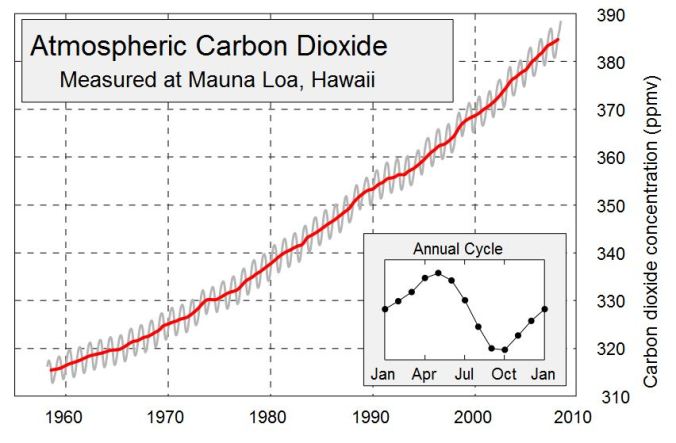
I didn’t know that the planetary albedo was going to go up and the atmospheric CO2 concentration was going to go down during this century! The latest plot of CO2 from Mauna Loa indicates that the atmospheric concentration is still on an upward trend (see image below). This trend may very well continue with rapid economic development in countries like China and India. Whether planetary albedo will go up or down seems to be in debate. In any case it would be important for climate change models to incorporate the reduction in the predicted total solar irradiance. Are there any studies that have done this?


Image is from http://en.wikipedia.org/wiki/Carbon_dioxide

NASA: Global warming caused mostly by humans

NASA: Global warming caused mostly by humans

Probing the Role of the Sun In an Era of Global Warming

Probing the Role of the Sun In an Era of Global Warming.
Yale environement360 Opinion, Analysis, Reporting & Debate
Be sure to check out the comments.


Source of photograph: Solar Feeds News and Commentary

New Satellite Takes Spectacular High-Res Image of Earth

New Satellite Takes Spectacular High-Res Image of Earth

You can download the full image in extremely high resolution (8,000 x 8,000 pixels!).

Alexis Madrigal: How Climate Change Could Reshape the Internet Ecosystem, Too

How Climate Change Could Reshape the Internet Ecosystem, Too (by Alexis Madrigal of the Atlantic)

From Fellous and Gautier: A Surprising Side-Effect of Climate Change: A Fog of Confusion

A Surprising Side-Effect of Climate Change: A Fog of Confusion

Climate change entails significant social impact not least of which is induced by changes in the global water cycle: more precipitation here, less there, more droughts in dry areas, more floods in wet areas, melting glaciers, rising sea levels, changes in cloud cover, etc… Another side-effect is also apparent: a thickening fog in the public discourse that obscures the significance of irrefutable environmental change to human society.

Read article at at earthzine
By Jean-Louis Fellous and Catherine Gautier, posted on June 21st, 2010 in Climate, Earth Observation, Feature, Featured Person, OpEd, People, Weather

Rescued Meteorological Data for the Caribbean Region – Excellent Historical Resource

Rescued Meteorological Data for the Caribbean Region – Excellent Historical Resource
These data are stored in NOAA’s digital library under the heading: Data Rescue Caribbean. Many of the recorded measurements are from the first half of the 20th Century.

For other interesting historical NOAA documents, check out the following link: http://docs.lib.noaa.gov/rescue/

Twenty top predictions for life 100 years from now – BBC News

Twenty top prediations for life 100 years from now – BBC News

Wow!

CLIMATE IMPACT EQUITY LENS (CIEL) – CLIMATE CHANGE GETS PERSONAL

CLIMATE IMPACT EQUITY LENS (CIEL) – CLIMATE CHANGE GETS PERSONAL
Spanish Version

The Climate Impact Equity Lens (CIEL) is a new tool for comparing the net climate impacts felt by diverse individuals around the world, and for tracking individual impacts over time. CIEL demonstrates that climate change will affect each person differently.

At present, very little is being done to prevent dangerous climate change. Some people are already experiencing damages from changing temperatures and weather patterns, and from sea-level rise – but everyone is enjoying the “benefit” of not paying for more ambitious emission reductions. Looking only at today’s impacts, most – but not all – of us are net winners (saving more from inaction than we lose from climate damages). Over the course of this century, net losers will become more common; in the next century, it will be hard to find people who still benefit from inaction.

CIEL provides a graphic display of changes over time in each individual’s net economic impact from climate change. You can download several CIEL publications and a tool that allows you to input individual characteristics to estimate the personal impact of climate change.

The Climate Impact Equity Lens (CIEL) is a new tool for comparing the net climate impacts felt by diverse individuals around the world, and for tracking individual impacts over time. CIEL demonstrates that climate change will affect each person differently.

(Excerpted from CIEL website, 2011, Stockholm Environment Institute, 11 Curtis Avenue, Somerville, MA 02145, USA. Phone: 1(617) 627-3786. Email: CIEL@sei-us.org)