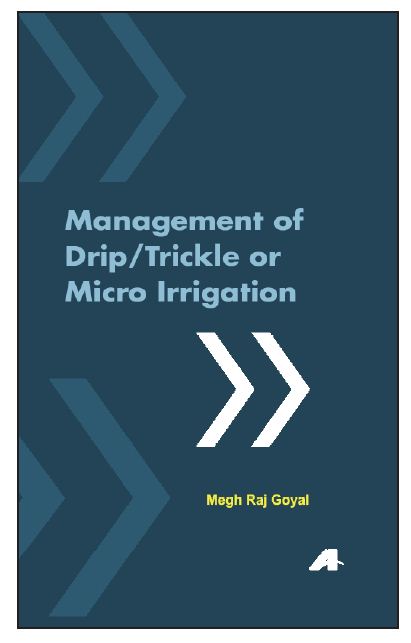
New Book Announcement: Management of Drip/Trickle or Micro Irrigation – Forthcoming Spring 2012

Management of Drip/Trickle or Micro Irrigation
By Megh R. Goyal, PhD, Professor in Agricultural and Biomedical Engineering, University of Puerto Rico

http://www.appleacademicpress.com

This important book—the only complete, one-stop manual on microirrigation worldwide—offers knowledge and techniques necessary to develop and manage a drip/trickle or micro irrigation system. The simplicity of the contents facilitates a technician to develop an effective micro irrigation system. Management of Drip/Trickle or Micro Irrigation includes the basic considerations relating to soil-water-plant interactions, with topics such as methods for soil moisture measurement; evapotranspiration; irrigation systems; tensiometer use and installation; principles of drip/ micro/trickle irrigation; filtration systems; automation; chloration; service and maintenance; design of drip irrigation and lateral lines; the evaluation of uniformity of application; and an economical analysis for selecting irrigation technology.

Agricultores podrían demandar a la Autoridad de Tierras

Agricultores podrían demandar a la Autoridad de Tierras

“Le han dado contrato a otras personas a $30 por cuerda cuando nosotros pagábamos $85 por cuerda”, dijo Hernández, quien tiene seis obreros en su finca.

See also: http://frapuertorico.wordpress.com/2012/02/12/en-pie-de-lucha-agricultores-en-el-valle-del-coloso-en-aguada/

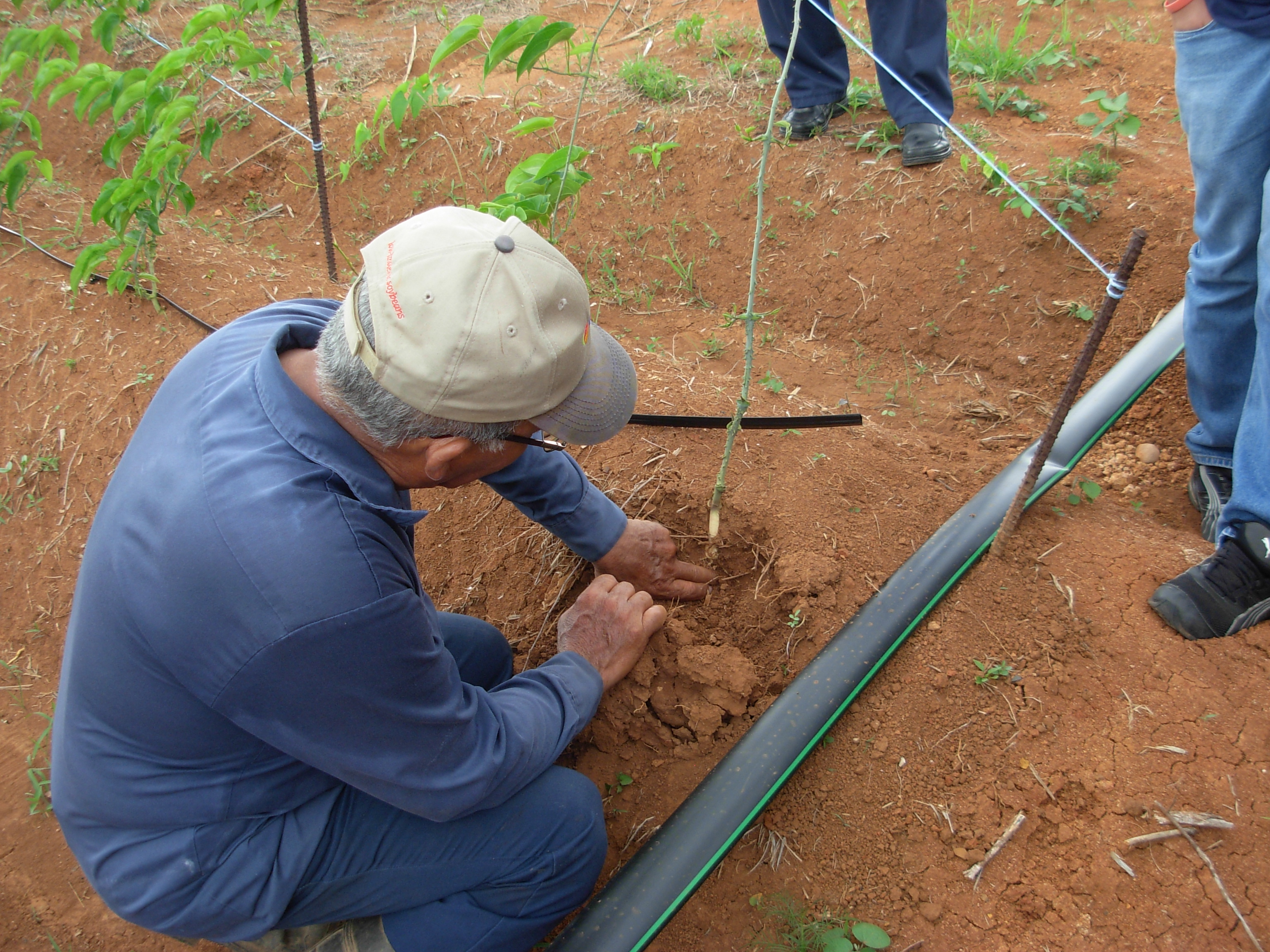
Photos from UPRM Soil and Water Management Class field trip to a farm in the Coloso Valley in 2011.

On Reading Old Things

On Reading Old Things is a great article by Jacquelyn Gill. All graduate students should read this article. At the beginning of this semester I assigned a reading by Gautier et al.(1980) and remember feeling a little embarrassed that the article, which is about satellite technology, was so old. Despite its age, however, the article is excellent and forms the basis of the satellite technology which we use to obtain the current hourly and daily solar radiation in the northern Caribbean. I could list other examples of old articles that are foundational and which should be read by anybody working in those fields. Gill mentions, and I have personally observed, that some journal reviewers sometime pressure authors to use recently published references and discourage older ones. Another practice that I have observed is that a journal will require that at least three references in the paper be from their journal. The reason for this of course is to jack up the rating of their journal, since they are rated on the number of times that their articles are cited. Anyhow, I highly recommend that you read On Reading Old Things.

From Gautier, C., G. R. Diak, and S. Masse, 1980: A simple physical model to estimate incident solar radiation at the surface from GOES satellite data. J. Appl. Meteor., 19, 1007–1012.

CROP WATER USE ( HARGREAVES ET EQUATION) WOLFRAM ALPHA WIDGET

CROP WATER USE ( HARGREAVES ET EQUATION) NEW WOLFRAM ALPHA WIDGET. Reference: Hargreaves, G. H. and Z. A. Samani, Reference Crop Evapotranspiration from Temperature. Appl. Eng. Agric., ASAE. 1(2). 1985,. pp.96-99.

Widget Application: Suppose you want to schedule irrigation by replacing the water evapotranspired by your crop each day.  1. Click on the appropriate link to get yesterdays solar radiation for your location: Puerto Rico or Northern Caribbean, 2. Check the internet for the average daily air temperature at your location (average = (minimum + maximum)/2),  3. Get the appropriate crop coefficient for your crop from this link, and 4. Finally, enter solar radiation, air temperature and crop coefficient into the widget to estimate ET. Multiply ET x acres x 1069.0663 to get the number of gallons of water you need to apply to your field.

Puerto Rico divided over energy future

Puerto Rico divided over energy future
Island split over natural gas pipeline and windfarm in move away from oil-based energy generation

guardian.co.uk, Thursday 26 January 2012

Frente Rescate Agrícola – Dile NO a la pérdida de terrenos agrícolas

Frente Rescate Agrícola – Dile NO a la pérdida de terrenos agrícolas

El Frente de Rescate Agrícola (FRA) es un movimiento de base popular que agrupa a diversas organizaciones civiles comprometidas con la agricultura y con un desarrollo sustentable del país. Este frente surge como propuesta a la preocupación colectiva de la pérdida desmedida de los terrenos agrícolas de Puerto Rico a causa de un desarrollo desenfrenado en beneficio de un supuesto progreso. El FRA se estará manifestando de diversas formas educando al pueblo y proponiendo alternativas para la preservación de los terrenos y para el progreso sostenible del país. Hemos llegado al punto donde la pérdida de una pulgada adicional de terrenos agrícolas representa una amenaza al sustento alimentario de las presentes y futuras generaciones.

Es momento ya de considerar la agricultura y los recursos naturales como pilar en el desarrollo del país. La crisis alimentaria que enfrenta Puerto Rico y agravada con la pérdida de terrenos agrícolas es un asunto de seguridad nacional y todo aquel que atente en contra de los terrenos está cometiendo una agresión directa al pueblo puertorriqueño.

Powered By Caffeine: A New Technology To Extract Energy From Coffee

Powered By Caffeine: A New Technology To Extract Energy From Coffee

PUERTO RICO SEISMIC NETWORK/RED SÍSMICA DE PUERTO RICO

PUERTO RICO SEISMIC NETWORK/RED SÍSMICA DE PUERTO RICO

Available in English
Disponible en español

Vision
To be the leading center in the monitoring, warning and information, research and education of earthquakes and tsunamis in the Caribbean.

Mission
Inform in a reliable and timely manner the generation and effects of earthquakes and tsunamis for Puerto Rico and Virgin Islands.

Rescued Meteorological Data for the Caribbean Region – Excellent Historical Resource

Rescued Meteorological Data for the Caribbean Region – Excellent Historical Resource
These data are stored in NOAA’s digital library under the heading: Data Rescue Caribbean. Many of the recorded measurements are from the first half of the 20th Century.

For other interesting historical NOAA documents, check out the following link: http://docs.lib.noaa.gov/rescue/